Dec 12, 2025
A Year in Review:
The AI Tools That Defined My 2025
Reading Time:
12 Minutes
Category:
AI in Education
A personal journey through the 33 AI tools
A Year in Review: The AI Tools That Defined My 2025
As 2025 comes to a close, I reflect on a year that redefined not only the capabilities of artificial intelligence but also our relationship with it. What once felt experimental has become embedded in our daily lives. Theoretical discussions have turned into practical tools that now shape the way we think, learn, and work, whether we want it or not.
For those of us working at the intersection of technology, education, and innovation, this was not just a year of watching AI evolve. It was a year of building with it. We moved from testing prototypes to deploying solutions. We shifted from prompting language models to collaborating with intelligent systems.
This post is a personal reflection on the 33ish AI tools that most significantly shaped my work this year.
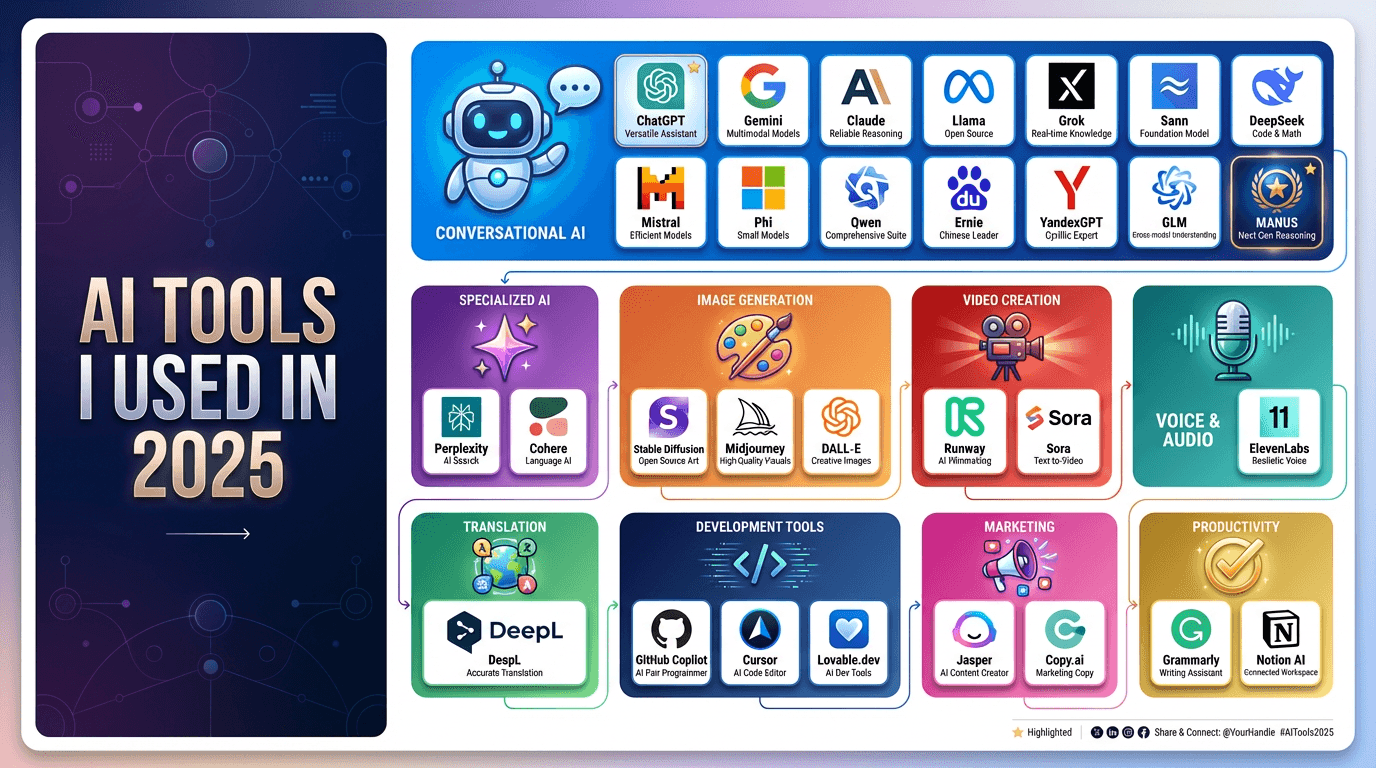
I want to focus on the stories behind the tools. This list is not exhaustive. It is a snapshot of a transformative year spent exploring what it means to co-create with intelligence that thinks alongside us.
Conversational AI Becomes Foundational
In 2025, conversational AI became a baseline utility. Much like a web browser or a word processor, it is now essential to my workflow.
ChatGPT and Google Gemini were my primary tools for research support, outlining articles, and generating drafts. They were reliable and efficient across a wide range of topics and tasks.
Claude, from Anthropic, became my preferred tool for working through nuanced or ethically sensitive material. Its alignment-focused architecture made it ideal for complex writing in education and research.
I also explored the open-weight model ecosystem. Meta’s LLaMA and Mistral AI offered the flexibility to fine-tune for specific use cases. For educators and developers looking to build tailored learning environments, this flexibility was a major step forward.
For tasks requiring more complex logic and precision, I used K2-Think for its advanced reasoning capabilities. I was turned on to K2-Think by friends in the UAE area and I am impressed with its speed.
DeepSeek is especially effective in coding workflows and algorithmic problem-solving.
These tools were not just helpful. They became collaborative partners in both creative and technical work.
The Shift Toward Autonomous Agents: My Experience with Manus
The most impactful development this year was my work with Manus. This autonomous AI agent marked a turning point in how I think about digital collaboration.
Manus is not a tool that waits for commands. It is a system that works toward goals. When I needed to prepare a comprehensive keynote on the future of AI in education, I gave Manus a single objective. It managed the entire process.
It conducted research across a wide range of sources. It synthesized the information into a structured multi-part report. It designed a compelling slide deck. It even wrote a full narrative script based on very specific prompts. Here it is, this is my secret sauce so far. Manus.
What would have taken a human team several weeks to accomplish, Manus accomplished in hours. More importantly, it did so with structure, clarity, and conceptual depth. This was not just automation. It was intelligent orchestration.
Manus understands context and plans strategically. It does not simply execute instructions. It interprets objectives and figures out how to meet them. That changed how I work. I spent less time on individual tasks and more time focusing on outcomes. This shift allowed me to think more creatively and lead more strategically.
The 2025 Toolkit: Specialized Tools That Transformed My Work
While foundational models offered consistency, specialized tools provided depth and precision.
Perplexity AI became my go-to research assistant. Its ability to deliver cited answers saved me hours of manual searching and note-taking.
In visual media, tools like Midjourney and DALL·E made it easy to prototype visual content. Runway and Sora allowed me to convert abstract ideas into video with impressive speed and quality. I now use Gemini for pictures, and since Manus integrates with Nano Banana, I don't need Gemini as much.
For global collaboration, DeepL enabled seamless communication with international partners. Its translations were both accurate and contextually sensitive. I wrote an entire book chapter for a project in Romania and used DeepL to translate the text and I was truly impressed. All the other tools translated the text in a way that was not usable. DeepL impressed me.
In development, GitHub Copilot and Cursor dramatically improved my coding speed. Lovable.dev showed strong potential in front-end automation, reducing repetitive user interface tasks and allowing me to focus on design logic. I developed multiple websites with it, and it worked really well for me.
On the productivity side, Grammarly and Notion AI were constant companions. They helped refine communication, organize thoughts, and manage projects more effectively.
Each of these tools brought its own kind of intelligence. Together, they created an environment where ideas could move quickly from concept to creation.
AI in Education: My Experience with Axio AI and the Rise of Neogogy
One of the most meaningful parts of my year was working with Axio AI. This platform is helping redefine what education can look like when AI is not an add-on but a core part of the learning experience.
Through Axio AI, I explored ways to create adaptive learning environments. We built systems that responded to students in real time. These systems adjusted content based on individual learning styles, performance, and engagement. It was not just personalization. It was transformation.
This experience helped reinforce a growing conviction. The future of education requires change at the pedagogical level. We cannot simply apply new tools to old systems. We need a new philosophy of learning.
That is where Neogogy comes in. While pedagogy focuses on how children learn, and andragogy on how adults learn, Neogogy explores how humans learn alongside machines. It recognizes that learning is now happening in a world filled with intelligent systems. It focuses on co-creation, contextual problem-solving, and dynamic feedback.
Neogogy invites us to rethink the structure of education itself. It calls for flexible learning journeys and fluid assessments. It challenges the idea of a fixed curriculum and encourages continuous adaptation.
If we want to prepare students for a world shaped by AI, we need to reimagine how education works at its foundation. We must move from content delivery to experience design. From standardized instruction to intelligent guidance.
Looking Ahead: Intelligence Everywhere, and the Unexpected Power of One
Looking back on this year, what strikes me most is not just how powerful these tools have become, but how much they have changed me. They changed how I work, how I think, and what I believe is possible.
This year, I found myself doing the work of ten people. I moved across roles and domains that were once outside my experience. I stepped into the shoes of researchers, designers, developers, translators, strategists, and educators. And somehow, I delivered.
These tools made that possible. They did not just make me faster. They made me bolder. They gave me the confidence to explore unfamiliar territory. I was able to solve problems and create value in areas where I had no formal background. Not because I had all the answers, but because the tools helped me ask better questions and act on the insights they surfaced.
My work with Axio AI made this especially clear. It showed me that the future of education is not about replacing teachers or learners. It is about augmenting our capacity to teach, learn, and create. It is about building environments where machines enhance human potential rather than compete with it.
This is why I believe Neogogy is essential. It gives us a framework to think about how we grow in this new context. A context where the learner is not alone, and neither is the teacher. Where intelligence is everywhere, and learning is no longer limited by what we already know.
I did not just adopt new tools this year. I found a new rhythm of work. A new way of seeing what is possible when you stop working alone.
The future is not something we wait for. It is something we begin to shape now. And for the first time, I feel like I am building with it rather than chasing after it.