May 31, 2026
AI in K-12 Education:
Evidence, Judgment, and the Work Machines Should Not Replace
Reading Time:
7 Minutes
Category:
AI in Education
The stakes are high in K-12. Are we paying attention?
The Evidence Is Smaller Than the Hype
K–12 education is not my primary world. At the college where I serve, however, we share our campus with a large international K–12 school. From time to time, I’m invited into that space, whether to present or participate, and each visit leaves me with a deep appreciation for the educators who have chosen that calling. Their work is demanding, complex, and profoundly important, even if it is not the context in which I personally operate.
This post is not drawn from direct expertise in K–12 practice, but rather from careful attention to emerging research, particularly recent findings from Stanford on the role of AI in education. As someone who closely follows the development of AI in learning environments, I find the K–12 sector especially instructive. There is much we can learn from how it engages, tests, and responds to these technologies.
This reflection, then, is offered with humility and curiosity, an attempt to surface insights from K–12 that may shape how we all approach AI in education.
AI is already inside K-12 education, whether districts have approved it or not. Teachers are using it to plan lessons. Students are using it as a tutor, an answer engine, a writing assistant, and sometimes a confidante. The question is no longer whether AI will enter schools. It already has. The question is whether schools can make it serve learning rather than let it quietly redefine learning as faster output.
Stanford HAI's and Stanford SCALE’s 2026 review is useful because it cuts through both enthusiasm and panic. The review examined more than 800 papers in the AI Hub Research Repository as of October 2025 but found only 20 high-quality causal studies that estimate AI’s effects on K-12 students or educators. That number should sober every procurement meeting. We are discussing system-wide adoption on a serious, but still narrow, evidence base.
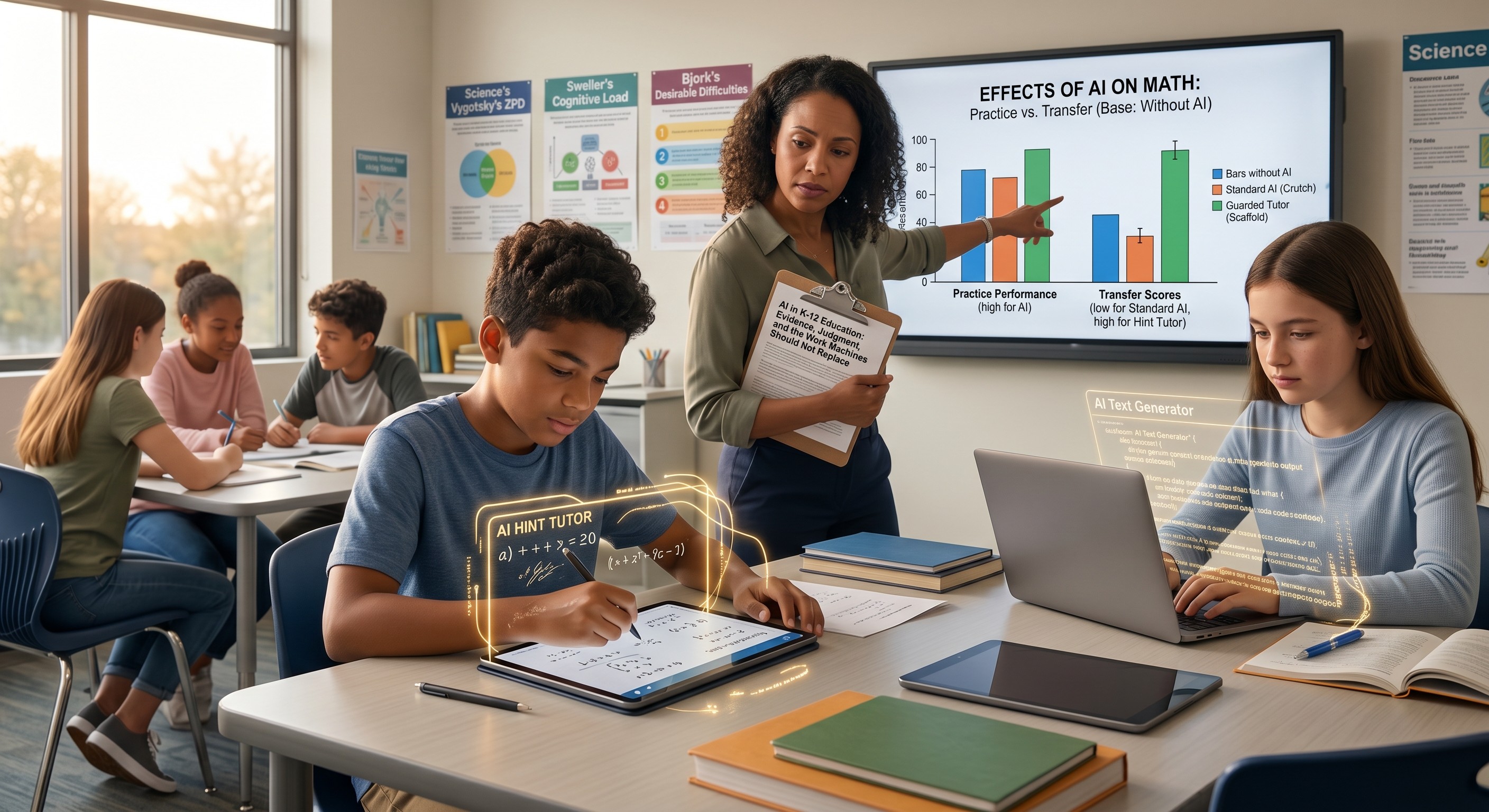
The central lesson is sharp: AI can raise performance while weakening learning. If a student solves more problems with AI beside them, we still have to ask what remains when the tool is gone.
The Finding Every School Leader Should Remember
The clearest warning comes from a PNAS field experiment with nearly 1,000 high school math students. Students using a standard GPT-4 interface improved practice performance by 48 percent. Students using a guarded GPT tutor improved by 127 percent. But when AI access was removed, the standard GPT-4 group performed 17 percent worse than students who never had AI access. The guarded tutor, which offered teacher-designed hints rather than direct answers, largely avoided that harm.
That is the whole AI-in-education debate in one study. The same underlying technology can become either a scaffold or a crutch. Design is not decoration. It is the difference between building capacity and outsourcing thought.
Learning science explains why. John Sweller’s cognitive load theory shows that instruction should reduce unnecessary mental burden so students can build schemas. But Robert and Elizabeth Bjork’s work on desirable difficulties reminds us that not all difficulty is waste. Some struggle is the very condition of durable learning. AI is valuable when it removes confusion that blocks learning. It is dangerous when it removes the productive effort through which learning happens.
The Best AI Tutor Should Not Answer Too Quickly
Vygotsky’s zone of proximal development gives schools a simple test: good assistance expands what a learner can later do independently. A tutor who gives hints, asks students to explain, and slows down premature fluency may be educationally useful. A tutor who produces the answer before the student has wrestled with the problem may only create the appearance of competence.
Scaffolding means support that increases a learner’s future independent capacity, not support that merely improves an immediate output.
Barnett and Ceci’s work on transfer sharpens the point. Success in one assisted context does not automatically transfer to a new problem, a later test, an oral explanation, or independent judgment. Schools should therefore stop asking only whether AI improves immediate scores. The better question is: Can students still explain, apply, and transfer the idea without the tool?
That question should shape assessment. The next generation of AI-aware schooling will likely split learning into AI-supported practice and AI-free demonstrations of understanding. This is not anti-technology. It is pro-learning.
Teacher-Facing AI Is the Most Credible Near-Term Use
The strongest near-term case for AI may be less dramatic than robot tutors. It may be teacher support. In an NFER and Education Endowment Foundation trial, 259 Year 7 and Year 8 science teachers across 68 schools used ChatGPT to prepare lessons and resources. In weeks six to ten, they spent 69 percent of the preparation time used by the comparison group, saving about 25 minutes per week, while blind expert review found no evidence that lesson-resource quality declined.
That is a concrete benefit. It is also a bounded one. AI looks most defensible when it helps teachers draft, adapt, question, and revise while leaving professional judgment intact. The U.S. Department of Education is right to insist that educational AI should be human-in-the-loop, aligned with learning goals, inspectable, explainable, and overridable.
The danger is not that teachers use AI. The danger is that institutions use AI to normalize thinner staffing, scripted instruction, or machine-generated materials accepted without review. Time saved only matters educationally if it becomes better teaching, richer feedback, or more attention to students.
Education Is Not Output Production
The philosophical issue is simple but often ignored: schools are not factories for polished work. John Dewey understood education as the reconstruction of experience for democratic life, not merely the delivery of information. Hannah Arendt argued that education involves adult responsibility for introducing children into a shared world. Both thinkers help us see why AI policy cannot be reduced to efficiency.
AI produces fluent outputs. Education forms people capable of judgment. Those are different achievements. A student who can generate a persuasive paragraph has not necessarily learned how to weigh evidence. A child who receives instant answers has not necessarily learned how to stay with difficulty. A school that accelerates production may still weaken formation.
This is the moral center of the debate. AI should support the human work of education, not replace the slow development of attention, memory, reasoning, responsibility, and trust.
Equity and Wellness Are the Next Frontiers
The Stanford Review notes that major evidence gaps remain around equity, student wellness, and social development. Those gaps matter because AI will not land evenly. Strong schools may use it to enrich teaching. Under-resourced schools may be sold cheaper substitutes for human support. Families with AI literacy may teach children how to question outputs. Others may inherit opaque systems that collect data and shape learning without meaningful oversight.
UNESCO’s guidance is therefore right to call for privacy protection, age-appropriate use, ethical validation, and pedagogical design. Equity is not access alone. Equity means asking who benefits, who is monitored, whose data is extracted, and whether AI supplements or replaces human relationships.
Wellness may become a harder issue. Common Sense Media reported that nearly three in four teens have used AI companions, half use them regularly, one third have chosen them over humans for serious conversations, and one quarter have shared personal information with them. EDSAFE describes these systems as part of a “shadow” learning environment, often outside school safeguards.
That should move AI policy beyond plagiarism. Schools will need rules for AI companion access on school devices, crisis disclosures, data retention, and the boundary between tutoring and simulated intimacy. The most serious failures may not come from AI-written homework. They may come from treating emotionally responsive systems as if they were ordinary search boxes.
The Takeaway: Scaffold, Do Not Substitute
The evidence does not support blanket adoption or blanket refusal. It supports a sharper standard. Use AI where it helps teachers teach and students become more independent. Limit it where it replaces the productive struggle through which competence forms. Reject it where it exploits children’s data, simulates care without responsibility, or converts schooling into output production.
Four questions should guide every AI decision in schools. Does the tool improve later independent performance, not just assisted performance? Does it give hints, prompts, and feedback rather than direct completion? Does it keep teachers in authority over instruction? Does it protect privacy, age-appropriateness, equity, and emotional safety?
The future of AI in education will not be decided by the technology alone. Schools will decide whether they remember what education is for.
Cited References
[1] Stanford SCALE and HAI, Understanding the Evidence Base on AI in K-12 Education
[2] Stanford SCALE, The Evidence Base on AI in K-12: A 2026 Review
[4] NFER, ChatGPT in lesson preparation: A Teacher Choices Trial
[5] UNESCO, Guidance for generative AI in education and research
[6] U.S. Department of Education, Artificial Intelligence and the Future of Teaching and Learning
[7] John Sweller, Cognitive Load During Problem Solving: Effects on Learning
[10] John Dewey, Democracy and Education
[11] Lev Vygotsky, Mind in Society: The Development of Higher Psychological Processes
[12] Hannah Arendt, The Crisis in Education
[13] Common Sense Media, Talk, Trust, and Trade-Offs: How and Why Teens Use AI Companions