May 23, 2026
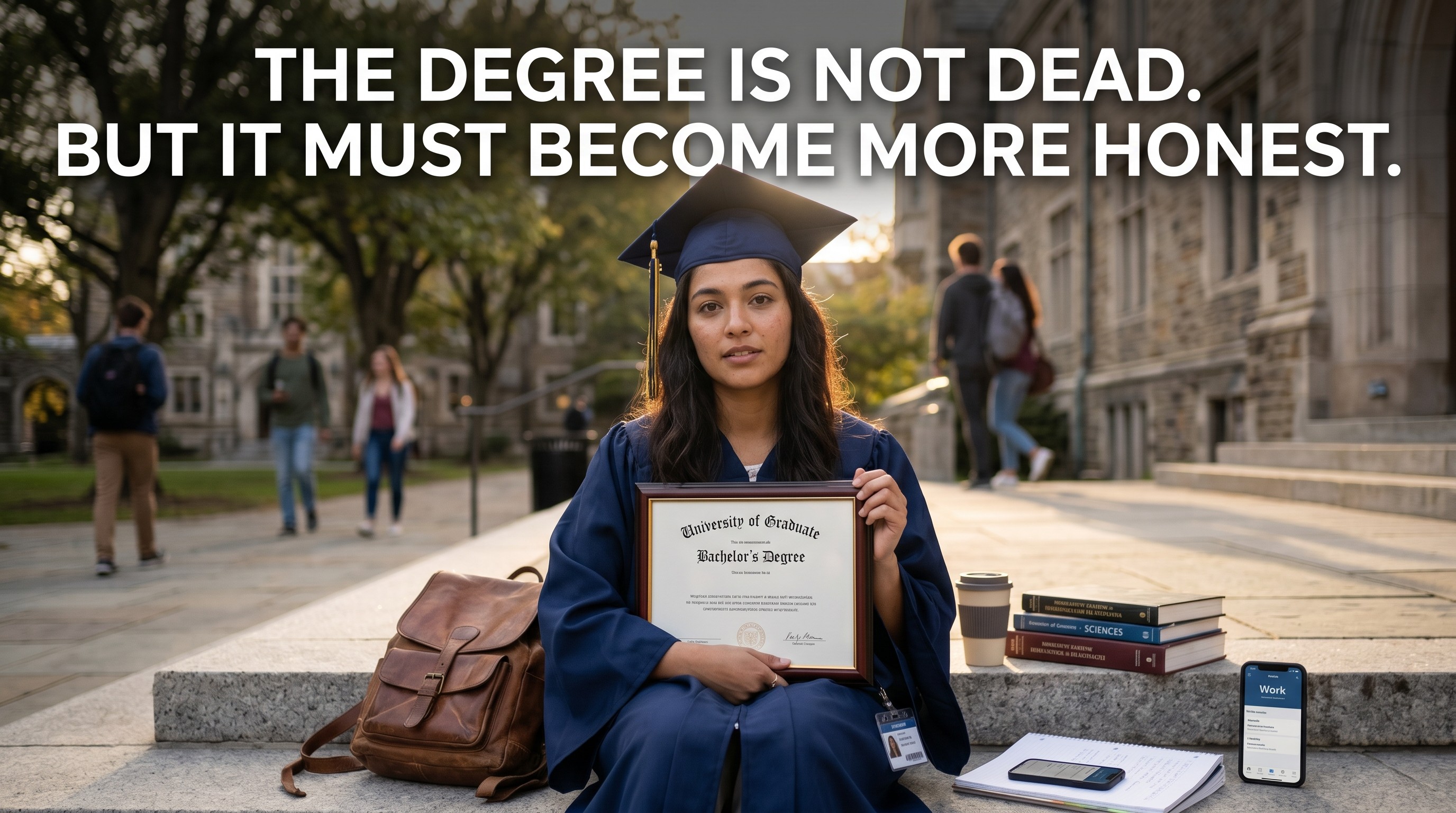
The Degree Is Not Dead
But It Must Become More Honest
Reading Time:
5 Minutes
Category:
Ai in Education
Is the college degree dead? Not if we look carefully.
Every few years, someone tells us that the university is about to be displaced. The new language changes from decade to decade. Occasionally, the challenger is online learning. Sometimes, it is boot camps. Today, artificial intelligence, skills-based hiring, and a labor market impatiently reject anything that they cannot measure immediately.
There is truth in the criticism. Higher education has too often asked families to trust the old bargain without explaining it clearly enough, pricing it responsibly enough, or connecting it visibly enough to the work students hope to do. As someone who leads a higher education institution, I do not think we should answer skepticism with defensiveness. We should answer it with evidence, humility, and a deeper account of what education is for.
The evidence is more complex than the slogans. Gallup reports that only 35 percent of Americans now say college is “very important,” down from 70 percent in 2013. Yet the labor market continues to reward postsecondary education. The Bureau of Labor Statistics reports that in 2024, bachelor’s degree holders earned a median of $1,543 per week, compared with $930 for workers with the highest credential of a high school diploma. Their unemployment rate was also lower, 2.5 percent compared with 4.2 percent.
So the question is not whether college still matters. It does. The harder question is why it matters, for whom, under what conditions, and what universities must do to deserve that continued relevance.
Economist Michael Spence gave us one unavoidable answer in his classic theory of job-market signaling. In uncertain markets, employers use education as a signal because they cannot directly know a candidate’s discipline, persistence, judgment, or capacity to learn before hiring them. A degree is never a perfect signal. Sometimes it reflects privilege as much as merit. Sometimes it conceals as much as it reveals. But in a labor market flooded with AI-polished résumés and rapidly submitted applications, employers are predictably reaching again for signals that feel costly, structured, and socially legible.
That is one reason recent reports of employers returning to degrees, GPA, and target-school recruiting should not surprise us. The more frictionless the application becomes, the more valuable trusted forms of friction become. A transcript, a completed degree, a demanding major, a serious internship, a faculty recommendation, and a record of sustained work all communicate something that a generated cover letter cannot. They say that a student has lived under standards for a long time.
But this is only the economic argument, and it is not enough. If universities defend themselves merely as credential factories, we will have accepted the smallest possible version of our mission. John Henry Newman argued that a liberal education forms the intellect by teaching people to see relations among things, to weigh evidence, and to cultivate judgment rather than mere accumulation of facts. Martha Nussbaum later insisted that democratic societies need education not simply to produce workers but to form citizens capable of critical thought, imagination, and sympathy.
Those claims may sound idealistic until we look at the world students are entering. Artificial intelligence will not eliminate the need for human judgment. It will raise the price of it. When information becomes abundant, the capacity to access answers becomes scarce. It is the disciplined ability to ask better questions, test premises, interpret consequences, and understand the human stakes of technical decisions. Cognitive scientist Stanislas Dehaene describes learning as the construction of internal models through attention, error correction, consolidation, and active engagement. That kind of learning is slow, effortful, and social. It is not downloaded. It is formed.
This environment is where higher education remains uniquely relevant. A good university does not merely transmit content. It creates an ecology of formation: structured difficulty, expert feedback, peer comparison, ethical inquiry, public argument, and time. Students learn not only what to think, but how to submit their thinking to standards beyond preference. They encounter disciplines that resist them. They discover that competence is not the same thing as confidence.
The next decade will make this distinction even more important. My projection is that by the early 2030s, entry-level hiring will divide into three tracks. First, regulated and high-trust fields such as health care, education, engineering, finance, and public administration will continue to require degrees because institutional accountability demands verifiable preparation. Second, technical and digital fields will use more performance-based assessments, but the strongest candidates will still combine portfolios with formal education, because employers will want both evidence of output and evidence of intellectual durability. Third, low-signal white-collar roles will become more unstable, precisely because AI can imitate many surface features of competence.
In that world, the degree will not function as a magic passport. It will function as part of a thicker record of formation. The winners will not be institutions that simply defend the old credentials. They will be institutions that make the credential more transparent, more rigorous, and more closely tied to demonstrable capability.
That means universities must change. We should build programs where students graduate with both breadth and evidence: writing that can be read, projects that can be inspected, internships that are supervised, research that requires patience, and civic learning that connects freedom with responsibility. We should be honest that some degrees offer different returns, that debt changes the moral equation, and that career preparation is a worthy pursuit of liberal education. Work is one of the ways human beings participate in the world.
At the same time, employers should be honest too. If they say they have moved beyond degrees but quietly recruit from the same small set of campuses, they have maintained the status quo in opportunity. They have only moved the signal underground. Research by Raj Chetty, David Deming, and John Friedman shows that highly selective institutions still have powerful effects on elite outcomes, while some admissions advantages for affluent students are weakly related or unrelated to later success. That should make every university leader cautious about confusing prestige with virtue.
The future should not be a contest between degrees and skills. That is a false opposition. The best higher education develops skills but also gives them a moral, historical, scientific, and civic frame. A nurse needs technical competence but also judgment under pressure. An engineer needs mathematical skill, but also responsibility for consequences. A business graduate needs analytics, but also an understanding of institutions, trust, and human motivation.
The degree is not dead. What is dying is the lazy degree, the opaque degree, the degree that asks to be trusted without showing its work. What remains valuable is the education that forms people who can learn, judge, adapt, and contribute when the world changes faster than job descriptions.
That is the work higher education must recommit itself to now. Not nostalgia. Not credential worship. Not a retreat from accountability. Rather, a more honest promise: that a serious education is still one of the strongest ways we know to prepare human beings for work, citizenship, and lives of consequence.