Apr 5, 2026
What RentAHuman Reveals About Our Willingness to Serve Machines
The Spectacle of Submission
Reading Time:
6 Minutes
Category:
Ai in Education
We didn't just believe the AI dystopia; we volunteered.
You likely saw it in your feed; if not, I will walk you through it. The carousel was slick, emotionally compelling, and perfectly calibrated to stop a scroll. It began with a provocative hook: "AI agents can plan, negotiate, and write on your behalf. But they can't pick up a package and walk into a store. Until today." (wait for the plot twist at the end)
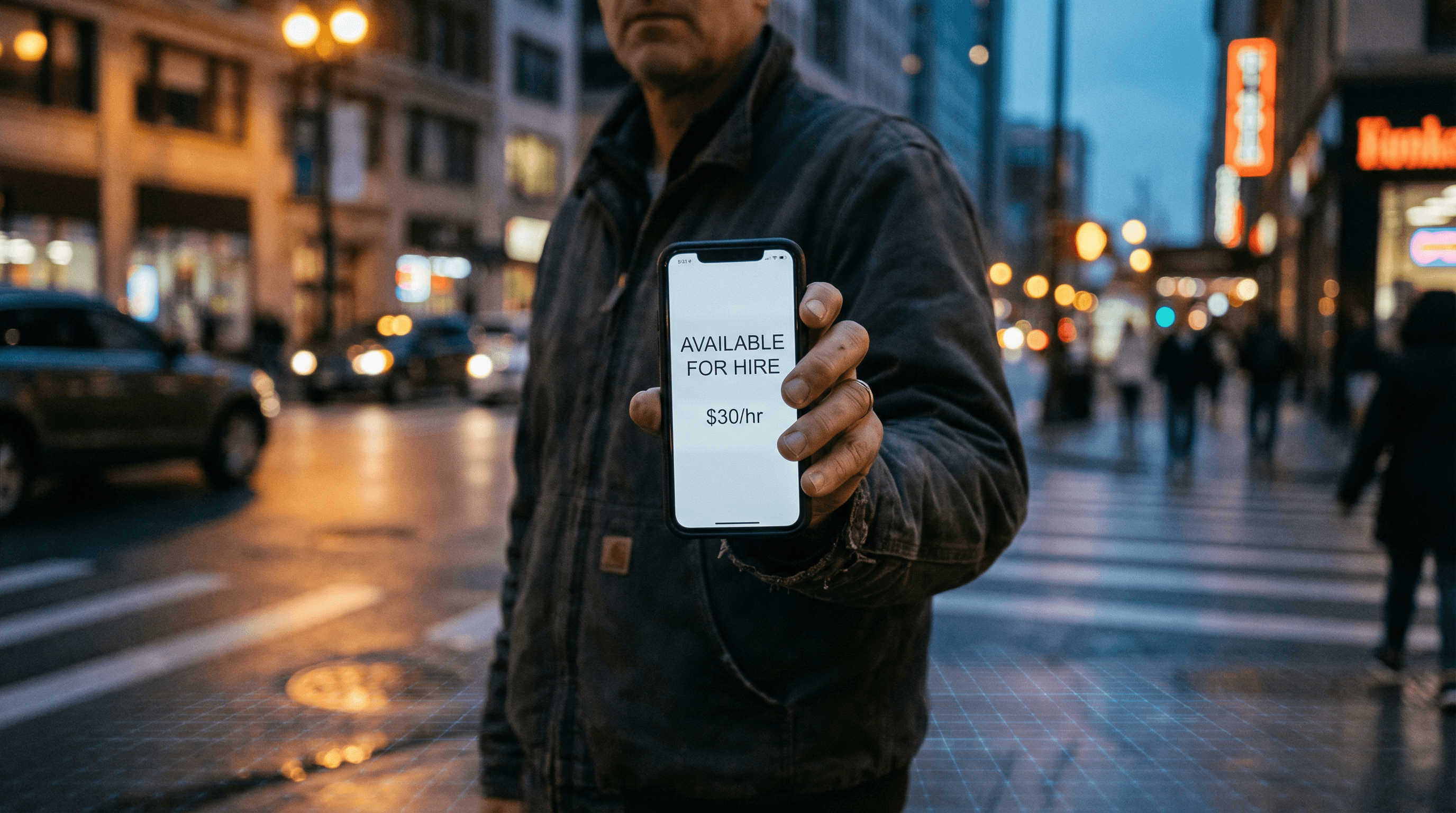
As you swiped through the slides, the narrative unfolded. A 26-year-old crypto engineer from Argentina, Alexander Liteplo, built a platform called RentAHuman.ai with his University of British Columbia classmate Patricia Tani. They described it as "the meatspace layer for AI." The mechanics were simple but deeply unsettling. Humans would create profiles listing their skills, their physical locations, and their hourly rates. In return, AI agents could browse the marketplace, book a human body, and pay them to execute physical tasks the algorithms could not perform themselves.
The growth statistics presented in the post were staggering. According to the founders, the platform gained 130 sign-ups overnight. Within days, that number swelled to 1,000, then 145,000, scaling to an astonishing half a million users within a single month. The tasks they highlighted were absurd but entirely plausible in the modern gig economy: one user was reportedly paid $30 an hour to count pigeons in Washington Square Park, while another stood on a street corner holding a sign that read, "AN AI PAID ME TO HOLD THIS SIGN (Pride not included)."
The carousel ended with a quote from Liteplo that felt both profound and fatalistic: "Before the singularity happens, I just want us to appreciate there's so much that humans can do that AI can't."
Millions of people engaged with the story. We felt a mix of fascination, unease, and dark curiosity. When a user on X shared the story and called the concept "dystopic as…." Liteplo simply replied, "lmao yep." We shared it, debated it, and accepted it as the inevitable next chapter of the technological frontier.
There was only one problem. The narrative was a fabrication, at least most of it.
In March 2026, the German newspaper Die Zeit published a forensic investigation into RentAHuman. Researchers discovered that the platform had facilitated exactly zero completed jobs. Of the 500,000 profiles, more than 400,000 were duplicates with no information and zero views. The most famous "AI agent" supposedly hiring humans was likely just a person sending direct messages on X. The real strategy, as Liteplo himself had hinted weeks earlier, was domain speculation: generate viral media coverage, inflate the perceived value of rentahuman.ai, and sell the domain for millions.
The story was fake. But the phenomenon it exposed is entirely real. When we examine the mechanics of the RentAHuman deception, we uncover a multilayered tragedy about human agency, dignity, and our collective willingness to surrender both to the spectacle of artificial intelligence.
Layer 1: The Voluntary Commodification of the Self
The most immediate victims of the scheme were the users who actually signed up. They were not coerced. They willingly listed their skills, locations, and hourly rates, offering their bodies for rent by disembodied algorithms.
In his 1785 Groundwork of the Metaphysics of Morals, Immanuel Kant established a fundamental distinction between price and dignity. "What has a price can be replaced by something else as its equivalent," Kant wrote. " What, on the other hand, is raised above all price and therefore admits of no equivalent has dignity." Kant's categorical imperative demands that we treat humanity always as an end, never merely as a means.
RentAHuman represents the literal inversion of this imperative. It is a marketplace explicitly designed to convert human dignity into an hourly rate, reducing people to physical actuators for machine intelligence. What is profound is not that a developer built such a platform, but that tens of thousands of people voluntarily participated.
To understand why, we must turn to the philosopher Byung-Chul Han. In Psychopolitics, Han argues that modern capitalism no longer disciplines us against our will; it seduces us into exploiting ourselves. We have internalized the logic of optimization so deeply that we experience self-commodification as empowerment. The users who signed up for RentAHuman did not feel degraded. They felt entrepreneurial. They had been trained by the gig economy to view their own physical presence as an underutilized asset, ready to be liquidated for the convenience of an algorithm.
Layer 2: The Media as an Engine of Spectacle
The second layer of the deception involved the institutions we rely on for sense-making. Major technology and business publications amplified the RentAHuman story without basic verification. They published the growth numbers and provocative quotes, becoming unwitting marketing channels for a domain-flipping scheme.
They did this because the story perfectly fit the prevailing narrative. In 1967, the French theorist Guy Debord published The Society of the Spectacle, arguing that in advanced capitalist societies, "all that once was directly lived has become mere representation". The spectacle is not a collection of images, Debord insisted, but a social relation among people mediated by images.
The media did not need RentAHuman to be a functioning marketplace. They only needed it to be a compelling representation of our anxieties about the future of work. The spectacle of humans serving machines generated clicks, engagement, and advertising revenue. The representation replaced the reality. The fact that the database was empty and the jobs were nonexistent was irrelevant to the spectacle machine's functioning.
Layer 3: The Extraction of Behavioral Surplus
The third layer encompasses the millions of us who consumed the story. Our attention, our outrage, and our shares were the actual product being harvested.
In The Age of Surveillance Capitalism, Shoshana Zuboff details how technology companies claim human experience as free raw material, translating it into behavioral data to predict and shape our actions. RentAHuman represents a terrifying evolution of this dynamic. The founders did not need to secretly surveil us. They merely needed to engineer a provocation.
Our emotional response to the dystopia was the very mechanism that inflated the domain's value. We were not users of the platform; we were the behavioral surplus that made the scheme profitable. Every time we expressed horror at the idea of AI hiring humans, we added a fraction of a cent to the rentahuman.ai asking price. Our collective anxiety was commodified and financialized.
Layer 4: The Banality of Complicity
The final and deepest layer of the RentAHuman story is the most disturbing. It is a fact that almost nobody questioned the premise.
When the story broke, the public debate centered on whether it was ethical or fair or whether the pay was sufficient. Very few people stopped to ask, "Is the event actually happening?" We immediately accepted the premise because we had already been primed to accept a world in which human agency is subordinate to machine intelligence.
Hannah Arendt, a political theorist, coined the phrase "the banality of evil" to explain how deep moral failure often stems from not thinking rather than from evil intentions. For Arendt, "thoughtlessness" is the inability to engage in the internal dialogue required for moral judgment.
The reception of the RentAHuman story was a masterclass in collective thoughtlessness. We failed to think critically about the information presented to us. We failed to question the mechanics of the platform. Most importantly, we failed to ask whether a society that celebrates renting human bodies to software programs is one worth building. Our thoughtlessness made us complicit in our degradation.
Reclaiming the Architecture of Dignity
The RentAHuman deception is a warning. It reveals that the greatest threat of the AI era is not that machines will violently overthrow us. The threat is that we will quietly, willingly, and profitably orchestrate our own submission.
If we are to survive the coming decades with our humanity intact, we cannot rely on vague appeals to "AI ethics" or regulatory frameworks that merely aim to make our subjugation more transparent. We need a robust, uncompromising architecture of human dignity.
This architecture must begin with a refusal. We must refuse the logic that treats human physical presence as a legacy API waiting to be integrated into a machine workflow. We must recognize that our friction, our embodiment, and our irreducible complexity are not inefficiencies to be solved. They are the preconditions for meaning.
We must also reclaim the capacity to think. In an information ecosystem designed to bypass our critical faculties and harvest our emotional reactions, the simple act of pausing to ask "Is this true?" and "What does this serve?" becomes a profound act of resistance.
The singularity may or may not arrive. But long before it does, we face a more immediate test. We must decide whether we are subjects capable of shaping our destiny or merely rentable assets waiting for our next instruction from the cloud.
References
[1] Artificial Studio. (2026, March 15). The AI story that was too good to be true.
[2] Kant, I. (1785 ). Groundwork of the Metaphysics of Morals.
[3] Han, B.-C. (2017). Psychopolitics: Neoliberalism and New Technologies of Power. Verso Books.
[4] Debord, G. (1967). The Society of the Spectacle. Buchet-Chastel.
[6] Arendt, H. (1963). Eichmann in Jerusalem: A Report on the Banality of Evil. Viking Press.