Jan 18, 2026
Beyond the Panic(ish):
How Real Classrooms Are Turning AI Into a Tool for Equity
Reading Time:
7 Minutes
Category:
Ai in Education
When Teachers Stop Fighting AI and Start Co-Designing It
What does it look like when the promise of artificial intelligence meets the reality of the classroom? Not as a distant headline, but as a lived experience for students and teachers on the front lines?
This question is no longer a futuristic abstraction. As a recent Harvard Gazette article, “What’s working, not on front lines of AI in classroom,” makes clear, the era of AI in education is not coming; it is here . Educators are moving past the initial panic of containment and are now deep in the messy, vital work of integration. They are asking the hard questions, not about whether to use these powerful new tools, but how to do so with wisdom, equity, and a profound respect for human dignity.
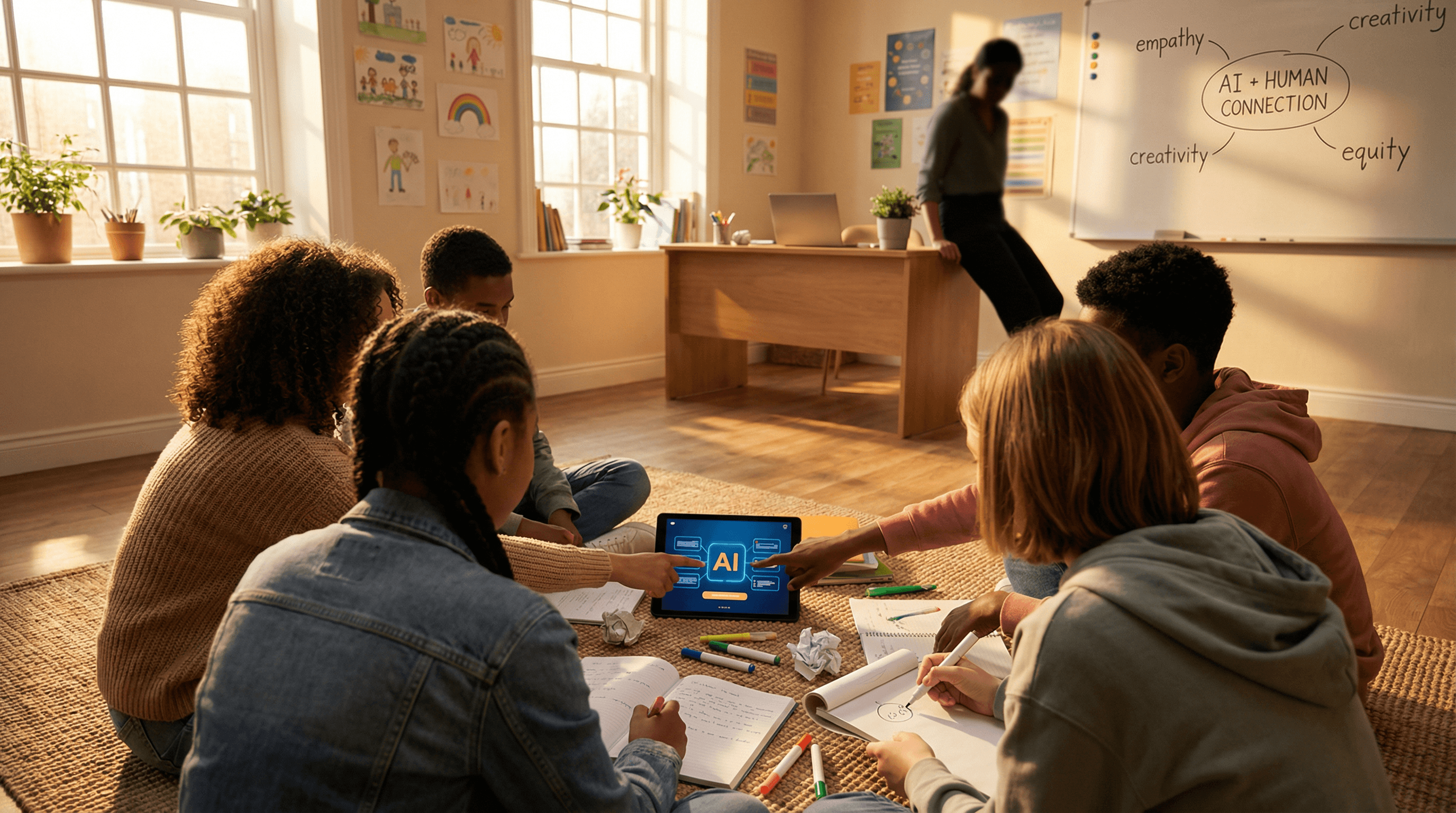
The conversation has shifted from a technological arms race to a deeply human endeavor. It’s a shift from viewing AI as a potential threat to be policed, to seeing it as a partner that, if guided with care, can help us build more equitable and empowering learning environments. The stories emerging from the front lines are not tales of robotic efficiency, but of human ingenuity and a renewed focus on what matters most in education: the unique spark within every learner.
Beyond the Hype: Finding the “Productive Struggle”
One of the most compelling narratives comes from Kedaar Sridhar, co-founder of the startup M7E AI. His work offers a powerful counter-narrative to the fear that AI will simply make learning too easy. Sridhar’s platform analyzes and simplifies the language of complex STEM curricula, not to eliminate difficulty, but to re-focus it. As he notes, the goal is to “remove unnecessary or irrelevant struggle and focus on the productive struggle” .
This is a critical distinction. So much of the anxiety around AI in education centers on the loss of rigor. But what if AI could help us strip away the confusing jargon and convoluted phrasing that often masquerades as rigor, allowing students to engage more deeply with the core concepts? Sridhar’s work suggests that AI can be a tool for clarity, helping students grapple with “the desirable difficulties that come with actually building up a student’s core of knowledge” . It’s about empowering students to question, to make decisions, and even to challenge the outputs of the AI itself—a crucial skill in a world saturated with algorithmically generated content.
The Microschool as a Modern-Day Laboratory
In the Elizabeth City-Pasquotank Public Schools of North Carolina, Superintendent Keith Parker is pioneering a different kind of innovation. Faced with economic challenges and a shortage of resources, Parker has established a “microschool” to serve as a hub of AI experimentation . This small-scale learning environment, with just a handful of teachers and students, provides a safe and agile space to test new strategies before scaling them. It’s a model of thoughtful, iterative innovation that stands in stark contrast to the top-down, one-size-fits-all technology mandates that have so often failed in education.
Parker’s experiment is not just about technology; it’s about pedagogy. The focus, he says, is on teaching students how to craft effective prompts, a skill that is rapidly becoming a cornerstone of modern literacy. In his microschool, students are learning to engage with AI as a creative partner, generating character guides for novels or even prompting chatbots to take on the persona of historical figures for a Q&A session. This is not passive consumption of information; it is active, critical engagement. As Parker powerfully states, “We’re in the midst of a massive revolution in K-12 education” , and it is being led by those who are willing to experiment with courage and creativity.
Co-Designing the Future, Centering the Human
Perhaps the most vital thread running through these stories is the call for a more collaborative and human-centered approach to technology development. Yenda Prado, a research analyst at the nonprofit Digital Promise, argues that the path forward requires a fundamental shift in how we create and implement educational AI. “We need to have educators involved in the actual co-design of these technologies,” she insists.
This is a profound and necessary call to action. For too long, educational technology has been developed in a vacuum, with solutions designed by engineers and then handed down to teachers. The result has been a landscape littered with tools that are disconnected from the realities of the classroom. Prado’s vision, and the work of organizations like Digital Promise, points to a more promising future—one where researchers and developers work alongside educators and students in a process of “rapid iterations of design” . This model of participatory design, as scholars like Anneli Tuhkala have noted, is essential to avoid the pitfalls of creating technology based on flawed assumptions about teaching and learning .
This collaborative spirit is particularly crucial when it comes to ensuring that AI serves all students, not just a privileged few. Prado’s work at Digital Promise is centered on closing learning gaps for the most vulnerable student populations—those in poverty, in rural communities, English language learners, and students with disabilities . By developing detailed “learner profiles,” she and her colleagues hope to train AI agents that can deliver truly tailored and equitable instruction. This is the promise of AI at its best: not as a tool for standardization, but as a means of honoring and responding to the unique needs of every individual learner.
The Path Forward: A Call for AI Literacy and Human Wisdom
The journey of integrating AI into our classrooms is just beginning. It is a path that requires not just technological savvy, but also a deep and abiding commitment to human values. As Prado wisely notes, “Once we understand the things that AI can and can’t do, we can start thinking about the types of tasks that AI could and should not be doing” . This requires a new and essential set of competencies, often referred to as AI literacy . It is about empowering our entire school communities—students, teachers, and leaders—to make informed, ethical choices about how to engage with these powerful new tools.
This is not a challenge we can afford to ignore. The stories from the front lines of education are a powerful reminder that the future of AI is not something that is happening to us, but something that we are actively creating, one classroom at a time. It is a future that will be defined not by the sophistication of our algorithms, but by the depth of our empathy, the courage of our creativity, and the wisdom of our choices.
What is one small, concrete step you could take this week to foster a more human-centered conversation about AI in your own community or classroom?
References
[2] Digital Promise. (n.d. ). About.
[4] Digital Promise. (n.d. ). Artificial Intelligence in Education.