Jan 31, 2026
Physical AI and Us:
Augmenting Humanity or Crossing Lines?
Reading Time:
5 Minutes
Category:
Ai and Workforce, AI in Education
The humanistic side of the robotics gold rush! Is there one?
Physical AI and Us: Augmenting Humanity or Crossing Lines?
A human-centered look at the rise of Physical AI and what it means for the future of our work or education.
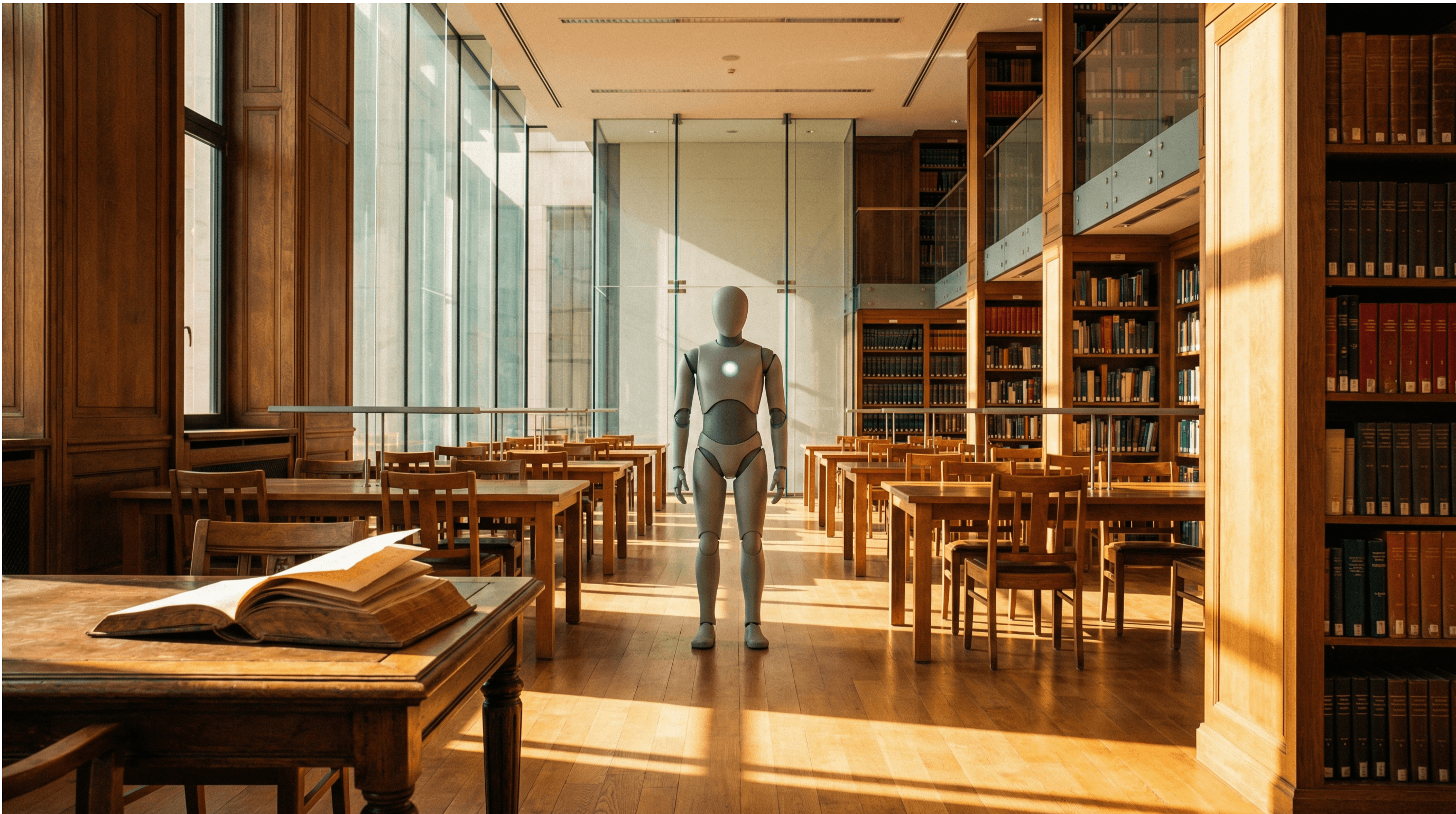
I recently found myself in a major mall in Manila, and I came face to face with the future. There, in the middle of the bustling lobby, stood a faceless robot on display. It wasn’t a toy or a gimmick; it was a silent, imposing presence that signaled a profound shift in our reality. This is no longer the stuff of science fiction. It’s here.
We see the signs everywhere. While educators and parents are grappling with how AI fits into the classroom, we may be overlooking a more startling possibility: that AI might soon walk into the classroom on its own two feet. This isn’t a far-fetched prediction. It’s the emerging reality of Physical AI, a technological wave quietly moving advanced robotics from controlled factory floors into the dynamic, unpredictable spaces of our everyday lives. Even Elon Musk, a figure synonymous with the electric vehicle revolution, is making a significant pivot, signaling a future where Tesla’s focus shifts from cars to robotics, which he calls the “biggest product of all time.”
Are we ready to have a real conversation about the proper use of this technology? A recent landmark report from Deloitte’s Tech Trends 2026 series, titled “AI goes physical,” makes it clear that this convergence of artificial intelligence and robotics is no longer a prototype. It’s in production. And it’s poised to reshape industries not by replacing humans, but by augmenting our capabilities in profound ways.
Beyond the Assembly Line: Physical AI in the Wild
For decades, robots have been a part of the industrial landscape, performing repetitive, pre-programmed tasks with superhuman precision. But Physical AI is something different. As Deloitte researchers note, these are not just automated machines; they are adaptive systems that can “autonomously perceive, understand, reason about, and interact with the physical world in real time.” What makes them revolutionary, the report emphasizes, “isn’t just task automation but their capacity to perceive, reason, and adapt.”
This is not a theoretical capability. It’s already happening:
• In cities like Dallas and Houston, Aurora Innovation has launched the first commercial self-driving truck service, a fleet of autonomous vehicles navigating public highways to deliver freight.
• Amazon has deployed over a million robots in its warehouses, not as caged-off machinery, but as a collaborative fleet working alongside human employees to fulfill orders.
• At BMW factories, newly built cars are driving themselves off the assembly line, a testament to how deeply autonomous technology is being integrated into complex manufacturing processes.
These examples reveal a crucial shift. We are moving from robots that follow a script to robots that can improvise. They are not just tools, but agents—able to make decisions, adjust to changing conditions, and interact with a world that was, until now, exclusively the domain of human beings.
What Makes These New Robots So Different?
The leap from rigid automation to fluid adaptation is powered by a convergence of technological breakthroughs. Unlike the AI in our phones or laptops, which operates purely in the digital realm, Physical AI must understand the messy, complicated laws of physics. It does this through a sophisticated blend of technologies.
At the heart of this evolution are vision-language-action (VLA) models. These are complex AI systems that, much like the human brain, integrate sight, language comprehension, and physical action. They allow a robot to not only “see” an object but to understand a verbal command like, “Please pick up that apple,” and then execute the delicate motor skills required to do so. This is made possible by advancements in onboard computing, with specialized processors allowing robots to make split-second, safety-critical decisions without relying on the cloud.
This is a far cry from the robots of the past. It’s the difference between a player piano and a jazz musician. One can perfectly replicate a song; the other can listen, feel, and create something new in the moment. It's a stretched metaphor, but use intentionally to show the stark difference and the major leap.
The Human Dimension: More Than Just Machines
Of course, this journey is not without its profound challenges. The transition from a simulated training environment to the real world remains one of the most significant hurdles. As Ayanna Howard, a leading roboticist and Dean of Engineering at The Ohio State University, explains in the Deloitte report, “A robot might learn to grab something in simulation, but when it enters physical space, it’s not a one-to-one match.” The nuances of lighting, texture, and unexpected obstacles create a complexity that is incredibly difficult to replicate digitally.
This is where the humanistic perspective becomes essential. The goal is not to create a perfect, sterile world for robots, but to build machines that are resilient, adaptable, and safe enough to navigate our world. This requires a deep sense of empathy and a focus on human dignity. The most successful applications of Physical AI will be those that are designed to assist and empower people, not to replace them.
Indeed, one of the primary drivers of this technology is the persistent labor shortage facing many developed nations. In this context, humanoid robots are not a threat, but a potential solution—a way to fill critical gaps in the workforce, handle dangerous or strenuous tasks, and free up human workers to focus on more creative, strategic, and interpersonal endeavors.
A Future We Build Together
The era of Physical AI is dawning. Deloitte predicts that the market for AI-powered humanoid robots in industrial settings could grow to over a quarter of a billion dollars by 2026, with annual shipments reaching 15,000 units. These intelligent machines are beginning to walk among us. They are inspecting our power grids, assisting in our surgeries, and stocking our warehouse shelves. They are becoming a part of the human story.
The most important question is not if we will work alongside them, but how we will choose to do so. As we stand at this remarkable intersection of human ingenuity and artificial intelligence, we have the opportunity to design a future where technology serves to elevate our work, enhance our safety, and ultimately, amplify our own humanity.
But as we race toward this new frontier, are we pausing to consider the deeper questions? What are the moral, ethical, and even spiritual implications of adopting a transhumanist approach in this new gold rush for productivity and efficiency?