Dec 4, 2025
The 36-Month Countdown:
Myth or Reality
Reading Time:
12 Minutes
Category:
Ai in Education
The next 36 months may be higher ed’s most important window for transformation.
The 36-Month Countdown: Rethinking Education in the Age of AI
For months now, a provocative idea has been quietly echoing through the digital alleys where the future is being actively constructed: “You have about 36 months to make it.” This statement, made popular by social entrepreneur Dan Koe, has often been misunderstood as a kind of Silicon Valley countdown to wealth. But that interpretation misses the point.
As Koe clarifies, “I think you have 36 months before the definition of ‘making it’ is radically transformed” (Koe). That clarification caught my attention.
I am usually not one to be drawn in by clickbait hype, but I will admit I was curious. At first, I did not buy into the alarmist interpretation of a 36-month clock ticking down the demise of the university. But the more I read, the more I reflected, the more I engaged with the rapid advancements in AI, I began to see what Koe was pointing at. I believe it now. The definition of “making it” is about to be radically redefined, especially in education.
And that is what I want to explore here.
The Tesla Experience and the Professor's Dilemma
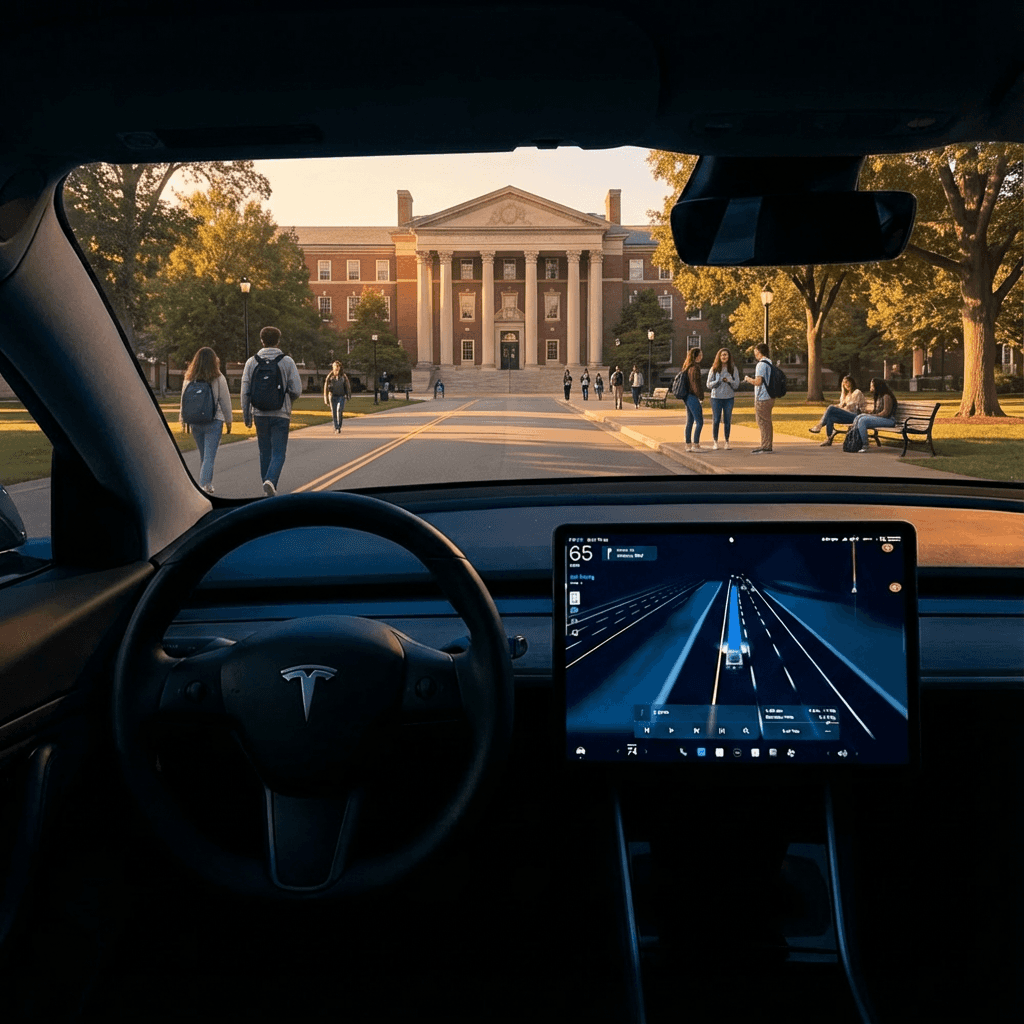
Last night, I finally tried out Tesla’s new Full Self-Driving (FSD) Supervised feature. I was running a quick errand to pick up dinner and decided to let the car handle the drive. To my surprise, it performed quite well. It navigated traffic, followed signals, and even parked itself. A couple of times I took control, not because the AI failed, but because I did not feel like waiting for it to find the ideal moment to change lanes. Only once did I feel a bit uncomfortable. The car made a right turn without fully accounting for an approaching vehicle around the corner. Still, it completed the trip safely.
What struck me most was not the technology. It was how I felt when I gave up control.
I have had access to this feature for some time but never chose to try it. I enjoy driving. I trust my own instincts. I like being alert, reading the road, and feeling every turn. On a previous trip to the Pacific coast, I gave Tesla’s Autopilot a brief try. After a mile, I turned it off. Not because it didn’t work, but because I enjoy driving. Especially on winding roads, it is something I want to do myself.
And that is when the connection became clear. This is likely how many professors feel today.
You have spent years, decades even, refining your craft. You know how to guide students, how to draw out ideas, how to respond to a classroom in real time. You do not just teach content. You shape minds. And now you are hearing that AI can do what you do. Perhaps not with the same depth or nuance, but faster and at scale. It is not just unsettling. It is deeply personal.
But just as the Tesla still needs a human in the driver’s seat, AI in education still needs the human voice, the human presence, the human judgment. Machines can assist, enhance, and support. But they cannot replace the wisdom, intuition, or purpose that educators bring to the experience.
The future is not about handing over the wheel entirely. It is about knowing when to steer, when to guide, and how to use the tools available to go further, together.
Real Conversations with Real Educators
This week, I had the opportunity to present a workshop on AI in education at the NWCCU National Conference. The room was full of university presidents, provosts, and faculty leaders. I expected skepticism, maybe even resistance. Instead, most raised their hands with excitement about AI’s potential. A few hands reflected concern, and that was welcome too. We need both curiosity and caution.
Later in the week, I co-hosted a webinar in partnership with Stefan Cel Mare University in Romania and COACH USV. Over 100 participants joined us, including professors, undergraduates, PhD students, postdocs, and researchers. The central theme was clear. Educators everywhere are asking not if AI will transform education, but how to lead through that transformation.
There was no panic in those conversations. There was purpose. And urgency.
Around the world, educators are waking up to a shared reality. The models we have trusted for decades are no longer enough. Not because they failed, but because the context has changed. The pace has shifted. And if we are to remain relevant, we must be willing to reimagine how learning works and who it is for.
What these conversations made clear is that technology is not the destination. It is the vehicle. And educators, still and always, must be in the driver’s seat.
A Global Clock Is Ticking
Across disciplines—from AI research to education policy to entrepreneurship—a growing number of voices are arriving at a similar conclusion. We are in a 36-month window where systems that once felt secure are being fundamentally reshaped.
This is not just theory. It is based on serious technical and strategic assessments.
Former OpenAI researcher Leopold Aschenbrenner lays out one such forecast. He writes, “The AGI race has begun. We are building machines that can think and reason. By 2025 or 2026, these machines will outpace many college graduates. By the end of the decade, they will be smarter than you or I. We will have superintelligence in the true sense of the word” (Aschenbrenner).
It is a bold prediction. Others, like John Lennox, offer a more skeptical perspective. In 2084: Artificial Intelligence and the Future of Humanity, Lennox argues that we are not close to building accurate artificial general intelligence and raises significant concerns about the tech industry's overpromises. I will share more about Lennox’s arguments and the impressive citation list he uses in an upcoming book review, as his theological and philosophical reflections bring essential balance to this discussion.
For now, it is worth examining the voices that do believe this change is coming quickly—and what they are proposing we do about it.
The Emerging Consensus
What I have found in the research is a clear convergence. Though these experts come from different fields, their conclusions align in powerful ways.
Expert | Perspective | Core Insight |
|---|---|---|
Dan Koe (Entrepreneur) | The Koe Letters | The future of work is about meaning, not just execution. AI will demand we evolve into philosopher-builders (Koe). |
Leopold Aschenbrenner (AI Researcher) | Situational Awareness | AGI is closer than we think. The next few years will redefine human-machine relationships (Aschenbrenner). |
Linda Darling-Hammond (Education Policy) | Learning Policy Institute | The industrial model of education is broken. We must rebuild around relationships, creativity, and real-world relevance (Darling-Hammond). |
Michael Clune (Academic Critic) | The Atlantic | Integrating AI without thought may erode the very skills students need most—creativity, depth, and critical thinking (Clune). |
Darling-Hammond points out that up to 30 percent of work hours could be automated by 2030 (Darling-Hammond). Yet we are still preparing students to compete in a race machines have already won.
Koe summarizes the shift in mindset with precision: “Machines are for speed, repetition, and necessity. Humans are for story, novelty, myth, and meaning. Those who lean into their humanity will thrive. Those who cannot stop identifying with mechanical living will not” (Koe).
We Do Not Need Reform. We Need Reinvention.
As someone who has led institutional change as a provost, built educational tools as an entrepreneur, and now serves as an international college president, I am convinced that the time for incremental reform is over.
We need something new. A new model. A new pedagogy.
I call it Neogogy.
Neogogy: Education for the Human Age of AI
Neogogy is built on one foundational principle. Education must be relentlessly human-centered.
As AI takes over the predictable and repetitive tasks, education must shift its focus to cultivating the capabilities that are uniquely human, creativity, moral reasoning, emotional intelligence, critical thinking, collaboration, and imagination.
Neogogy does not oppose technology. It leverages it. AI can personalize learning, reduce administrative burdens, and empower students with simulations and intelligent feedback. But it is always used with intention. In this model, the machine is the tool. The human remains the composer.
In a Neogogical classroom, the question is no longer what students know. It is what they can do with what they know. Success is measured not by standard tests, but by meaningful outcomes. Students are not passive consumers of content. They are creators, problem-solvers, and leaders.
We need smaller, more relational learning environments. Mentorship-driven learning. Performance-based assessments. Interdisciplinary thinking. And above all, a commitment to helping students discover purpose—not just credentials.
This is the kind of education that can thrive in the age of AI. One that is deeply human, technologically fluent, and purpose-driven.
The Countdown Is an Invitation
The 36-month countdown may sound bold, but it is not a threat. It is an invitation.
An invitation to move forward with clarity. To let go of outdated assumptions. To build a better future for learners and educators alike.
We have the tools. We have the insight. Now is the time to lead.
Works Cited
Aschenbrenner, Leopold. Situational Awareness: The Decade Ahead. 2024.
Clune, Michael. “Colleges Are Preparing to Self-Lobotomize.” The Atlantic, 2025.
Darling-Hammond, Linda. Educating in the AI Era: The Urgent Need to Redesign Schools. Learning Policy Institute, 2025.
Koe, Dan. You Have About 36 Months to Make It. The Koe Letters, 2025.