Jan 26, 2026
The Colonization of the Sacred:
why it really matters
Reading Time:
7 Minutes
Category:
AI and Art, AI in Education
AI creates content. Humans create meaning and content
The Colonization of the Sacred
I was flying from New York to Portland a while ago, mentally preparing to endure a long, cramped, six hour overnight flight in a middle seat. Next to me sat a gentleman, an artist. As we began to talk, he took out a dark piece of paper and a white pen and just started doodling. We ended up talking for five hours straight. I received a free masterclass in the art and beauty of painting. He revealed what makes a painting exceptional, explaining that novice painters often work at noon for the abundant light, while the experienced venture into the afternoon, where they have only minutes to capture a landscape in the fleeting sun. He spoke of the critical importance of composition, of laying a perfect foundation, a process that can sometimes take more work than the painting itself. That conversation was eye-opening: I had the chance to visit the Ashmolean Museum in Oxford and to see impressive art by world-renowned artists. It was not until Daniel took the time to explain the most intricate aspects of the artwork that I began to understand why they were revered as artists and what I was actually looking at.
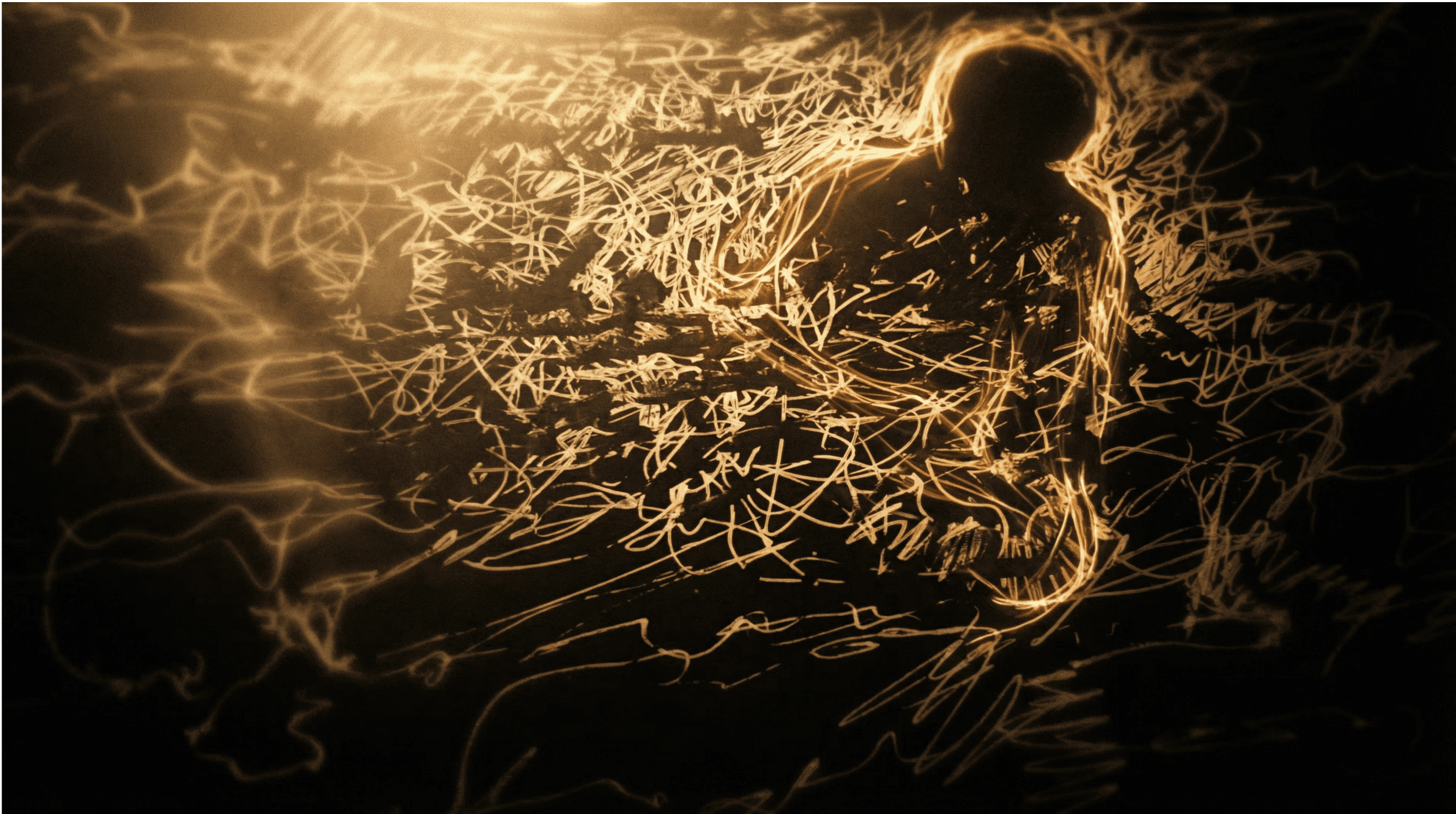
Throughout our deep conversation, as the cabin lights dimmed, he kept doodling. I couldn’t see much of what his hands were doing, captivated as I was by the shared experience. Then, the lights came on for landing. I saw the result of his work, and it was a powerful metaphor: a person defined and shaped by light.
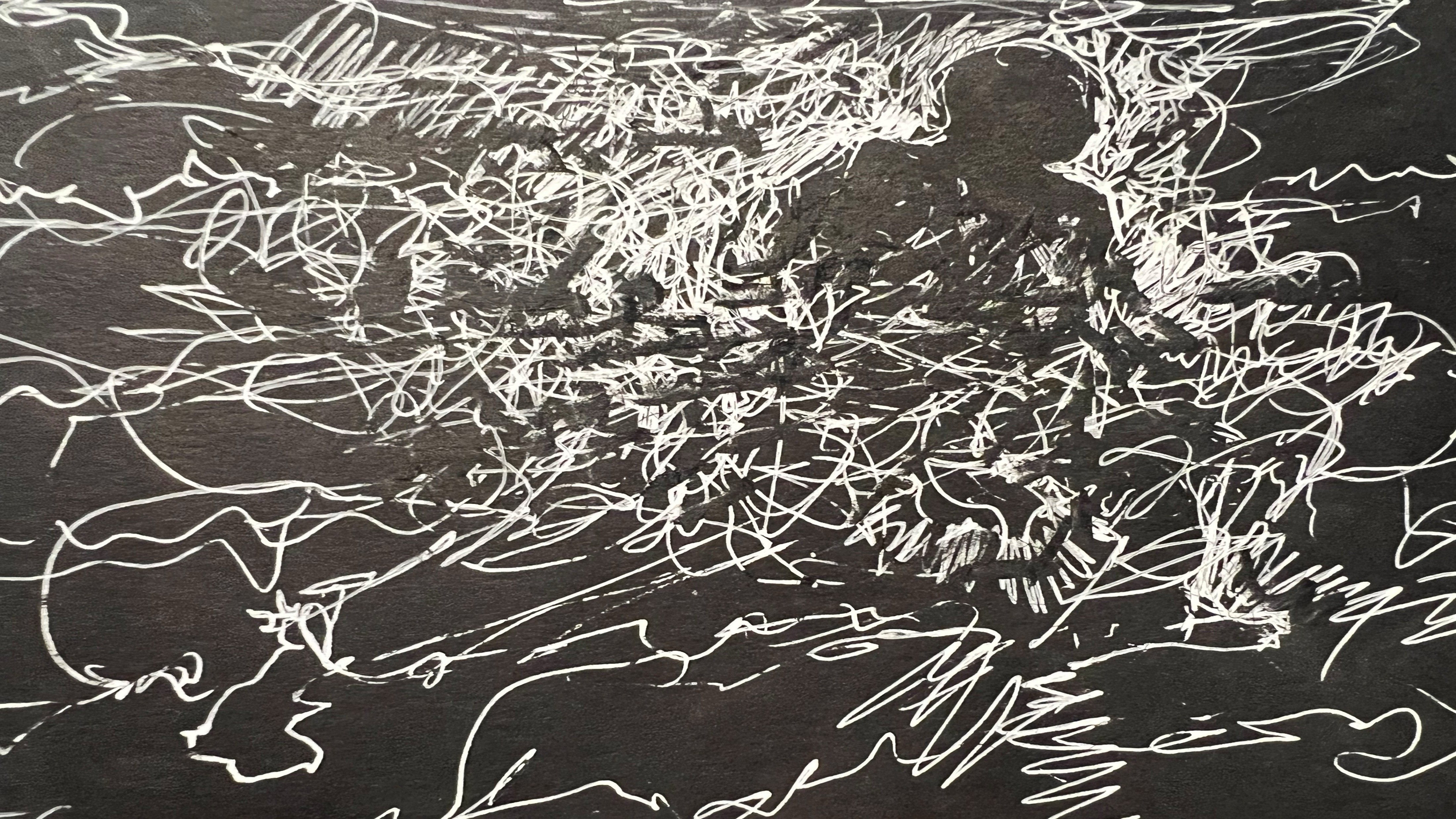
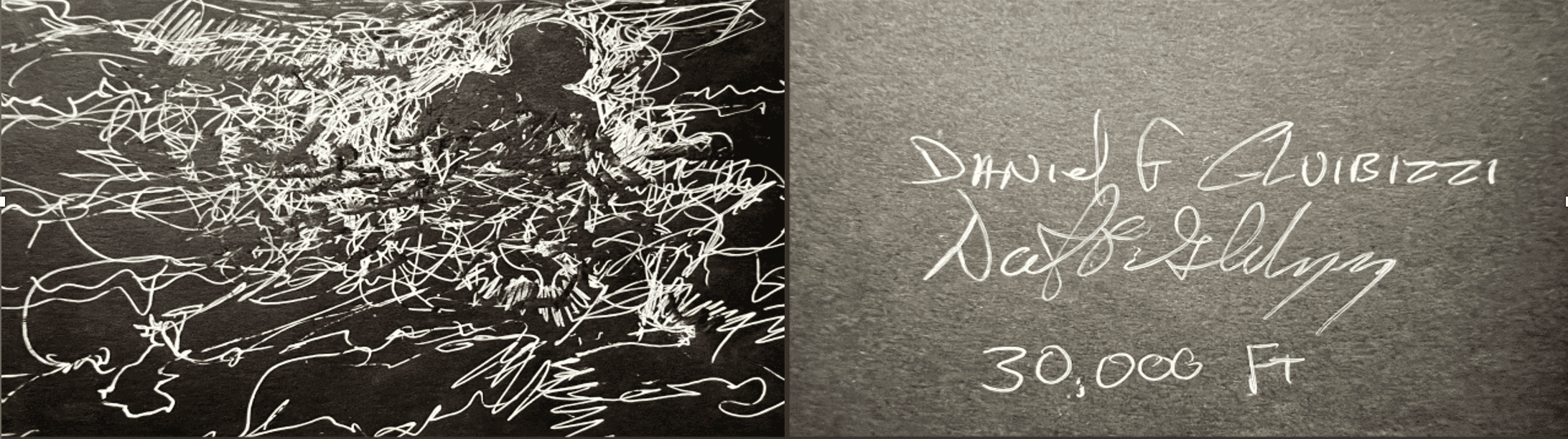
Daniel, the artist (@dfgluibizzi), saw me looking at it. He simply offered it to me and even signed it. I tried to refuse at least three times, as any Eastern European must do. But Daniel was gracious with me and insisted, and it really left a strong impression. My life lesson from this art was that we are only defined by the wonderful things we do, say or think. Everything else is background and noise. But the great things we do, define our personhood and reveal the human. We are to be light in this world, and light defines everything, giving it meaning and shape. How powerful is that?
At that moment, the shared experience, the spontaneous creation, and the generous gift were profound acts of human connection and meaning-making. It was messy, unplannable, and deeply personal. It is everything an algorithm cannot replicate. And it’s this very human core of creativity that feels under threat. We are living in a world where, as journalist Douglas McLennan puts it, artificial intelligence has begun to “colonize our creativity.” It’s a quiet occupation, happening not with force, but with the frictionless ease of a thousand daily algorithms.
This is not a distant forecast; the data shows the takeover is already well underway. A study by Five Percent, cited in McLennan’s incisive Post Alley article, reveals that over half of all new text online is now AI-generated. The French music platform Deezer reports that a third of its daily uploads (some 50,000 tracks) are created by machines. We are, in essence, living in a digital world that is increasingly for, and by, the machines.
This new landscape forces us to confront a deeper question, one that goes beyond technological capability. In a world where creation is becoming ambient, authorship porous, and meaning optional, what happens to the human urge to make? And more importantly, why do we still try when the culture, as McLennan asks, “doesn’t seem to care?”
The Seduction of the Seamless
The allure of AI generated content is undeniable. It’s fast, efficient, and increasingly indistinguishable from human work. A recent study found that 97 percent of listeners couldn’t even tell the difference between AI composed and human composed music. The technical quality is no longer in question.
Yet, as we wade through what many now aptly term “AI slop,” a sense of unease emerges. There is a frictionless quality to this content (a “calculated reality,” as McLennan describes it) that feels both impressive and empty. The videos are too perfect, the songs generically inspirational, the images emotionally sterile. They are like a digital Big Mac: mass produced, satisfying a momentary hunger, but lacking the nourishment of a thoughtfully prepared meal.
This is because true creativity is not about perfection; it is about the struggle. It is born from lived experience, from the messy, inconvenient, and often painful process of wrestling with an idea. It is, like my great friend George Comes says, the word "messenger" includes the word "mess". To send your message, you have to have gone through the mess. It is rooted in what philosopher David Lamberth of Harvard Divinity School calls “meaning making,” the deeply human act of interpretation and judgment. As Lamberth explains, the very word “intelligence” derives from the Latin intelligere, which suggests finding meaning “between the words.” It is an act of understanding (verstehen, in the German philosophical tradition), not just processing. AI, for all its power, operates on the level of explanation, not understanding. It can assemble data, but it cannot inhabit a life.
A Chorus of Experience: Lessons from Past Disruptions
Of course, every major technological shift has been met with anxiety. In the comments on McLennan’s article, a chorus of voices reminds us of these historical parallels. Photographer Lloyd Weller recalls the early 1990s when he and his peers believed Photoshop spelled the death of their craft. Yet today, he notes, both film and digital photography have found their place. Similarly, Christopher Kirk points to the advent of Computer Aided Design (CAD), which didn’t stifle creativity but instead enabled architects like Frank Gehry to design buildings that were “fundamentally different than anything seen before.”
These voices argue that new tools historically expand the creative imagination. But they also echo a crucial distinction made by McLennan himself: this time feels different. We are not just debating a new tool or style, but facing “an absorption of the making itself.” The question is no longer just about how we create, but who is doing the creating.
The Last Stand of the Human Artist
So where does this leave the human creator? Does our art become obsolete when a machine can do it faster and, by some metrics, better?
A groundbreaking 2026 study from the University of Montreal offers a nuanced and hopeful answer. After testing AI against over 100,000 human participants, researchers found that while AI like GPT-4 can now outperform the average person in certain creativity tasks, it falls far short of our most imaginative minds. “Peak creativity,” the study concludes, “remains firmly human.”
This suggests that the future of human art may not be in competing with AI on its own terms (on the battlefield of speed and optimization). Instead, it may be in retreating to the ground that machines can never occupy. As a growing chorus of artists and technologists insists, real art must be rooted in experience, decision, accident, failure, and the insistence of a point of view. It is in what McLennan beautifully calls “the stubborn, inconvenient business of deciding what something should be.”
This wrestling, this struggle, is not a flaw in the creative process; it is the creative process. It is the friction that generates the spark. It is the source of authenticity, the quality that makes a piece of art resonate with our own humanity. An AI can simulate emotion, but it cannot feel it. It can replicate a style, but it cannot have a history. It can generate endless variations, but it cannot make a choice born of love, loss, or longing, like the choice Daniel made to gift his drawing on that flight.
Finding Our ‘Why’ in a World of ‘How’
The conversation is no longer about what AI can do, but about what it means for who we are. That five hour conversation on the plane was not an algorithm. The doodle that emerged from the darkness was not a data point. It was a moment of shared humanity, a connection forged through conversation and a mutual appreciation for the creative spark. This is the essence of what we risk losing: not art itself, but the human context that gives it meaning.
This doesn’t mean we should reject AI outright. As many have argued, those who learn to wield AI as a tool will have a powerful advantage. A 2024 study published in PNAS Nexus found that text-to-image AI can enhance human creative productivity by 25 percent. The key is to see it as a partner, not a replacement, a copilot that can handle the technical tasks, freeing us up to focus on the uniquely human work of meaning-making.
The ultimate challenge, then, is not to prove that machines can’t make art. The market has already decided that they can. The challenge is to remember why we, as humans, still must. It is in the act of creating, in the struggle and the joy of bringing something new into the world from the depths of our own experience, that we affirm our own dignity and connect with the humanity of others. It is the only way to express the inexpressible, unleash generations' imaginations, and point the heart to the Divine. There are no substitutes and no "fast food" for that.
I still have the drawing Daniel gave me on that flight. It sits on my desk, a tangible reminder of a shared moment in the dark, 30,000 feet in the air. It is not just ink on paper. It is the residue of a conversation, a testament to a connection, a story of light emerging from darkness. An AI could generate a million similar images, but it could never reproduce the meaning embedded within this one. It could never create this gift. And that, in the end, is what we must fight to preserve: not just the ability to create, but the human experience that makes it matter.
Works Cited
McLennan, Douglas. “The AI that’s Colonized our Creativity.” Post Alley, 9 December 2025, www.postalley.org/2025/12/09/the-ai-thats-colonized-our-creativity/.
Jerbi, Karim, et al. “Researchers tested AI against 100,000 humans on creativity.” ScienceDaily, 25 January 2026, www.sciencedaily.com/releases/2026/01/260125083356.htm.
Lamberth, David. “Meaning Making, Bodies, and AI.” Harvard Divinity Bulletin, Autumn/Winter 2025, bulletin.hds.harvard.edu/meaning-making-bodies-and-ai/.
Zhou, E., & Lee, D. “Generative artificial intelligence, human creativity, and art.” PNAS Nexus, vol. 3, no. 3, 2024, pgae052, doi:10.1093/pnasnexus/pgae052.
Additional studies on content percentages and music perception were cited within McLennan’s original Post Alley article.