Dec 8, 2025
The University and the Wolf:
Why This Cry Might Be Different
Reading Time:
8 Minutes
Category:
Ai in Education
Universities survived the printing press and MOOCs. What about AI?
The University and the Wolf: Why This Cry Might Be Different
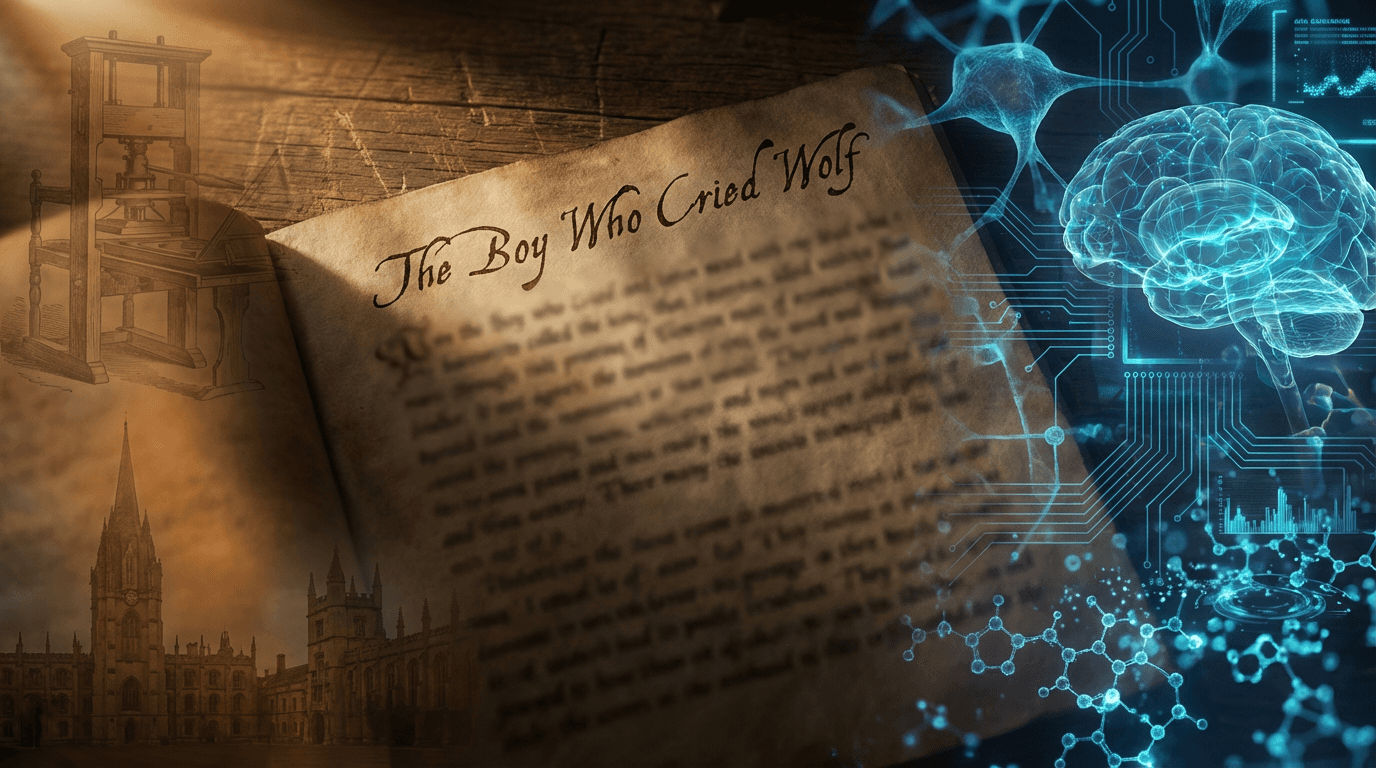
Every few decades, a new technology emerges that prompts a familiar chorus of predictions about the imminent demise of the university. A recent article in Minding the Campus offers a comforting historical perspective, arguing that since higher education survived the printing press, a technology that made knowledge vastly cheaper and more accessible, it will surely survive the rise of artificial intelligence (Gillen). The author, Andrew Gillen, reminds us that universities were not always the research and teaching institutions we know today. Their origins lie in a much more practical problem: the scarcity and cost of books.
When Books Cost as Much as Cars: The Birth of the Lecture
A thousand years ago, books were written by hand, making them exorbitantly expensive. Economist Brad DeLong estimated that a single book would typically cost about $50,000 in today's dollars (Gillen). For a student seeking a college-level education, the cost of acquiring the necessary books alone would have been approximately $1.6 million. This was not a system designed for mass education. It was a system for the exceptionally wealthy or those supported by religious institutions.
The university lecture emerged as an ingenious solution to this problem. As DeLong describes it, you would "assemble the hundred or so people who want to read Boethius's The Consolation of Philosophy in a room, and have the professor read to them, hence lecture, lecturer, from the Latin lector, reader, while they frantically take notes because they are likely to never see a copy of that book again once they are out in the world" (Gillen). The lecture was not a pedagogical ideal. It was an economic necessity.
Then came the printing press in 1440. Over the following centuries, it transformed the economics of knowledge. Today, that same work by Boethius can be purchased on Amazon for $9.91, a price reduction of 99.98 percent (Gillen). The lecture, in its original function as a substitute for expensive books, became obsolete. Yet lectures and universities persist to this day. This historical resilience is Gillen's central argument: if universities survived when their core function was rendered obsolete by technology, they will surely survive AI as well.
This historical parallel is both compelling and reassuring. It suggests that the university is a resilient institution, its value extending far beyond simple content delivery. But it also fits into a more recent pattern of institutional alarmism. We have, it seems, a habit of crying wolf.
The Last Time We Cried Wolf: Online Education and the Revolution That Wasn’t
This isn't the first time we've been told that technology would upend the ivory tower. A little over a decade ago, in what The New York Times famously dubbed "The Year of the MOOC," a similar wave of disruption was predicted (Pappano). The narrative was that Massive Open Online Courses would democratize education, allowing anyone with an internet connection to access elite instruction for free, thereby making traditional universities obsolete.
But the disruption narrative extended beyond MOOCs. For-credit online education had been growing steadily for years, with institutions like the University of Phoenix and Western Governors University offering fully accredited degrees entirely online. Traditional universities responded by launching their own online programs, and by the 2010s, nearly every major institution had some form of online degree offering. Administrators warned that universities failing to embrace online education would be left behind, unable to compete in a rapidly digitalizing world. The message was clear: adapt or die.
The predictions were bold and unequivocal. Sebastian Thrun, a Stanford professor and founder of the MOOC platform Udacity, famously forecasted that in 50 years, there would be only 10 universities left in the world (Watters). Influential columnists like Thomas Friedman declared that a "revolution" had hit the universities, one that would reshape the entire landscape of higher education (Friedman). The implication was that online education, whether through MOOCs or for-credit programs, would fundamentally displace the traditional campus-based model.
But the revolution never came. The wolf, it turned out, was just a shadow. Why? As Michael B. Horn of the Christensen Institute, the intellectual home of disruption theory, later acknowledged, even he came to believe that higher education would largely thrive despite the disruption (Horn). The reason is that universities provide far more than just knowledge. They offer credentials, networks, brand prestige, and a coming-of-age experience. Online education, for all its potential, failed to replicate this complex bundle of services. It became a supplement to, not a replacement for, the traditional university. The institutions adapted, the hype faded, and the wolf retreated into the forest.
Is AI the Real Wolf, or Just Another Cry?
Given this history, it is tempting to view the current anxiety around artificial intelligence as just another false alarm. We've heard this story before. But this dismissal, however comforting, may be a mistake. While the pattern is familiar, the nature of the challenge is fundamentally different. This time, the wolf may not be at the door, but already inside the house, changing its very architecture.
Two key differences separate AI from previous technological shifts. First, unlike online education, which struggled for widespread adoption and remained a niche offering for many years, AI has been embraced with astonishing speed. A 2025 survey found that 86 percent of college students are already using AI tools for their schoolwork (PBS NewsHour). This is not a prediction of the future; it is a present reality. AI is not an alternative platform that students might choose; it is a tool they are integrating into the existing system, with or without permission.
Second, and more profoundly, AI’s impact goes far beyond the delivery of content. The printing press and online education made knowledge cheaper and more accessible. AI, however, automates the very processes of thinking, reasoning, and writing that are supposed to be at the heart of learning. When a student can generate an essay with a simple prompt, and a professor can use a similar tool to grade it, we enter a strange new territory. One recent article in Current Affairs aptly calls this the "Chatversity," a place where students "pretend to learn" and faculty "pretend to teach" (Current Affairs). This isn’t about replacing the university; it’s about hollowing it out from within.
The Power of a New Microscope
The argument that AI is a fundamentally different category of technology is not speculative. It is based on its already proven ability to transform entire fields of discovery. As I explored in a previous post (https://alinvrancila.com/blog/the-new-microscopes), AI is not just another tool for analysis; it is a new kind of scientific instrument, a microscope for seeing the unseen. To see AI as just a better chatbot “is like looking at a steam engine and seeing only a carnival ride. The true revolution, the one that will fundamentally reshape our world, is happening in a place far less visible to the public: the research lab” (Vrancila, “The New Microscopes”).
This is not science fiction. It is happening right now. AI models like Google DeepMind’s AlphaFold have solved the 50-year-old grand challenge of protein folding, accelerating drug discovery for diseases from malaria to cancer. Another model, GNoME, discovered 2.2 million new crystal structures, a feat equivalent to nearly 800 years of human knowledge, paving the way for new battery and superconductor technologies. These are not incremental improvements. They represent a paradigm shift in how knowledge is created. AI is giving scientists “an unprecedented ability to see and understand the complex systems that govern life and the universe,” serving as “partners in discovery, capable of identifying patterns in massive datasets that would be impossible for the human mind to grasp” (Vrancila, “The New Microscopes”).
A technology with this level of demonstrated power to augment human intellect and accelerate discovery cannot be compared to the passive content delivery of a MOOC. It is an active agent in the creation of knowledge. This is why the challenge to education is so profound. If AI can co-author scientific breakthroughs, it can certainly co-author a term paper. The question is no longer if it will change education, but how we will adapt our educational philosophies to this new reality.
From Pedagogy to Neogogy: A Framework for the Future
If AI represents a true paradigm shift, then our models of teaching and learning must also shift. For centuries, education has been defined by pedagogy, the art and science of teaching children, a model based on the authority of the instructor. In the 20th century, we saw the rise of andragogy, which focused on the principles of adult learning, emphasizing self-direction and experience. More recently, heutagogy has emerged, promoting self-determined learning where individuals take full control of their learning paths.
AI does not fit neatly into any of these frameworks. It demands a new approach, one I call Neogogy. Neogogy is an educational framework that integrates aspects of pedagogy, andragogy, and heutagogy, specifically tailored for the digital age and powered by artificial intelligence. It is a model where the learner is at the center, supported by AI as a co-pilot, a mentor, and a tool for discovery. In a Neogogical approach, the goal is not simply to transfer knowledge (a task AI can increasingly handle), but to cultivate the uniquely human skills of critical thinking, creativity, and collaboration in a world where AI is ubiquitous.
The danger of AI is not that it will lead to a world with only 10 universities. The more subtle and serious danger is that it will lead to a world with thousands of universities that have lost their purpose. If the credential no longer signifies a student’s ability to think critically and communicate effectively, what value does it hold? This is not a challenge to the university’s business model, but to its very soul.
The question is not whether AI will be a game-changer for higher education. It already is. The question is how we will respond. This is not a time for panic, but it is certainly not a time for complacency. We have cried wolf before, but this time, the creature may be real, and it looks different than we expected.
Works Cited
Current Affairs. "AI is Destroying the University and Learning Itself." Current Affairs, 30 Nov. 2025, www.currentaffairs.org/news/ai-is-destroying-the-university-and-learning-itself.
Friedman, Thomas L. "Revolution Hits the Universities." The New York Times, 26 Jan. 2013, www.nytimes.com/2013/01/27/opinion/sunday/friedman-revolution-hits-the-universities.html.
Gillen, Andrew. "AI Will Make Knowledge Cheap. Higher Ed Will Survive Anyway." Minding the Campus, 1 Dec. 2025, www.mindingthecampus.org/2025/12/01/the-university-withstood-cheaper-knowledge-before-it-can-do-it-again/.
Horn, Michael B. "Why ‘higher ed’ will thrive as it gets disrupted." Christensen Institute, 8 Aug. 2025, www.christenseninstitute.org/blog/why-higher-ed-will-thrive-as-it-gets-disrupted/.
Pappano, Laura. "The Year of the MOOC." The New York Times, 2 Nov. 2012, www.nytimes.com/2012/11/04/education/edlife/massive-open-online-courses-are-multiplying-at-a-rapid-pace.html.
PBS NewsHour. "How artificial intelligence is reshaping college for students and professors." PBS, 25 Nov. 2025, www.pbs.org/newshour/show/how-artificial-intelligence-is-reshaping-college-for-students-and-professors.
Vrancila, Alin. "The New Microscopes: How AI is Revealing the Hidden Worlds of Science." AlinVrancila.com, 16 Oct. 2025, alinvrancila.com/blog/the-new-microscopes.
Watters, Audrey. "A Future With Only 10 Universities." Hack Education, 15 Oct. 2013, hackeducation.com/2013/10/15/minding-the-future-openva.