
Jan 9, 2026
What JPMorgan's 2026 Outlook Reveals About the Future of Education
And why we should pay attention
Reading Time:
8 minutes
Category:
Ai in Education, Future of Work
Three powerful forces are reshaping the global economy: are we paying attention?
"A seminal new cycle is dawning that will be defined by the promise and pressure of three big forces: AI, fragmentation, and inflation. Understanding these new economic realities and risks will be key to protecting and growing your wealth in the coming decade."
I recently spent time with JPMorgan's 2026 Global Markets Outlook, and I have to tell you, it's not just another financial report. While it's written for investors and wealth managers, the insights within it are profoundly relevant to anyone thinking about the future of education. The report identifies three transformative forces reshaping our world, and as I read through it, I couldn't help but think: these are exactly the forces that should be driving conversations in every school, university, and educational institution.
Banks like JPMorgan don't have the luxury of ignoring global trends. Their survival depends on correctly reading the signals and adapting quickly. When they declare that the fundamental rules of the game have changed, it's worth paying attention. And what they're seeing is a world being simultaneously accelerated by artificial intelligence, reshaped by geopolitical fragmentation, and challenged by a new era of economic volatility.
Here are the three critical takeaways from the report that I believe every educator, administrator, and policymaker should be thinking about right now.
1. AI Is Democratizing Expertise (And That Changes Everything for Learning)
What JPMorgan Is Seeing: The report describes AI as a force that "could drive the cost of expertise toward zero." This isn't hyperbole. The data is compelling: agentic AI models are on track to reach human-level performance by 2026, and companies that have adopted AI are already seeing labor productivity gains of around 30% . We're talking about over $1 trillion in planned capital expenditure from major tech companies, with AI investment tripling since 2023 .
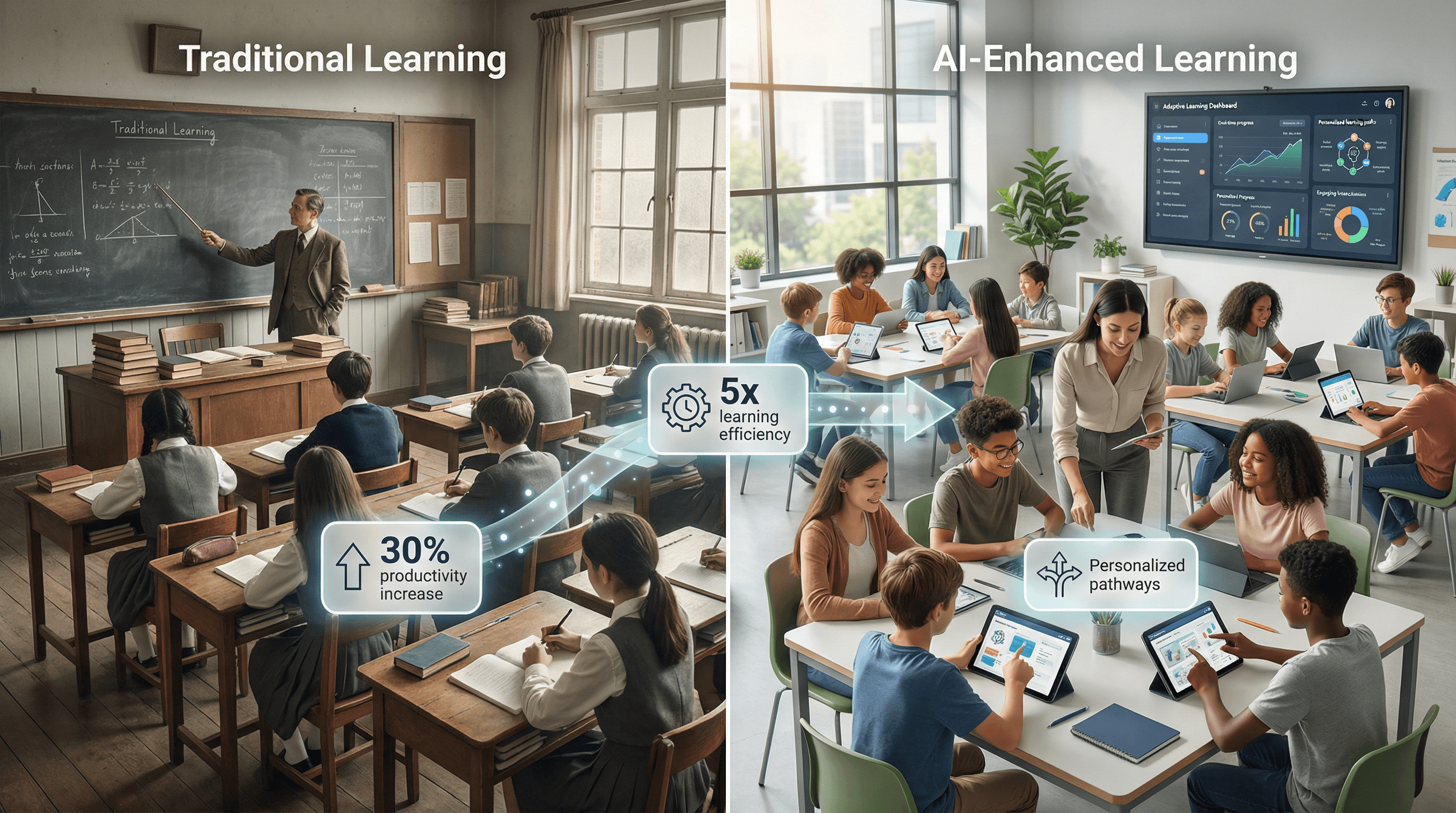
What This Means for Education: For centuries, education has been built on a simple premise: knowledge is scarce, and teachers are the gatekeepers. But AI fundamentally disrupts this model. When students can access world-class expertise through a conversation with an AI assistant, the traditional role of the teacher as the primary source of information becomes less relevant.
This isn't a threat. It's an opportunity. It frees educators to do what they do best: mentor, inspire, and guide. Instead of spending time delivering content that AI can provide instantly, teachers can focus on developing the uniquely human capacities that machines can't replicate. Critical thinking. Creative problem-solving. Empathy and collaboration. The ability to ask better questions.
The report notes that 71 million knowledge workers have jobs exposed to AI disruption. Our students will be entering this workforce. The question isn't whether they'll work alongside AI, but how well we prepare them to do so. This requires a fundamental shift in how we think about curriculum, assessment, and the purpose of education itself.
2. The World Is Fragmenting (And One-Size-Fits-All Education Won't Cut It)
What JPMorgan Is Seeing: The era of seamless globalization is "clearly over" . The world is reorganizing into competing regional blocs, and supply chains are being reconfigured not for maximum efficiency, but for maximum resilience and security. Trade is shifting from a model of "cheapest origin to rules of origin," where the reliability and political alignment of partners matter more than cost alone. This creates a more complex, multipolar world where regional dynamics take center stage.

What This Means for Education: A standardized, one-size-fits-all approach to education made sense in a flat, globalized world. But that world is changing. Students today need to understand complexity, navigate ambiguity, and think in systems. They need to grasp how economics, politics, geography, and culture intersect and influence each other.
This doesn't mean abandoning global perspectives. Quite the opposite. It means developing students who are globally competent but also deeply aware of regional contexts. It means teaching them to understand trade-offs between efficiency and resilience, between optimization and security. It means preparing them to be adaptive leaders in a world where the rules are being rewritten.
The fragmentation JPMorgan describes isn't just geopolitical. It's also an opportunity to embrace educational fragmentation in the best sense: personalized learning pathways, adaptive curricula, and individualized approaches that recognize that not every student learns the same way or needs the same things.
3. Economic Volatility Is the New Normal (And Static Credentials Are Losing Value)
What JPMorgan Is Seeing: Inflation is no longer just a cyclical challenge. It's becoming a structural feature of the economic landscape. The report emphasizes that inflation will not only be higher but, more critically, more volatile . This volatility makes long-term planning more difficult and erodes the value of static assets. In the investment world, this means portfolios need to be dynamic, adaptive, and built for resilience rather than stability.

What This Means for Education: The "purchasing power" of a traditional degree is changing. The assumption that four years of undergraduate education can provide a stable foundation for a 40-year career is increasingly outdated. Students are graduating into a world where career paths are non-linear, where the skills required today may be obsolete in five years, and where adaptability is more valuable than any single credential.
This calls for a fundamental rethinking of what we're preparing students for. Instead of delivering a fixed body of knowledge, we need to build the capacity for continuous, lifelong learning. We need to teach students not just how to learn, but how to relearn and adapt. Financial literacy, risk management, and personal resilience are no longer optional add-ons. They're essential life skills.
The volatility JPMorgan describes in financial markets has a direct parallel in education: the need for anti-fragile learning systems that don't just withstand change but actually thrive on it.
The Opportunity: A New Pedagogy for a New World
These three forces are not operating in isolation. AI accelerates fragmentation by enabling technological competition between nations. Fragmentation drives inflation by making supply chains more expensive. The convergence of these forces creates a fundamentally different world from the one our current educational models were designed for.
This is where the opportunity lies. We have a chance to reimagine education from the ground up, to build learning systems that are adaptive, personalized, and resilient. This is precisely what Neogogy.ai is designed to do.
Neogogy is an AI-powered, adaptive learning framework built for this new era. It embraces AI as a partner in learning, creating personalized pathways that meet students where they are. It thrives in complexity, offering individualized approaches that prepare students for a fragmented, multipolar world. And it's designed for volatility, providing a framework for continuous adaptation rather than static credentialing.

Banks are acting now because they understand that the window for transformation is narrow. First movers gain advantage. Delay increases risk. The same is true for education. Our students are graduating into a world that looks radically different from the one we prepared for. The skills gap is widening. Traditional credentials are losing their signal value. And new competitors, from AI tutors to alternative credentialing platforms, are emerging rapidly.
But here's the exciting part: this isn't a story of decline. It's a story of possibility. The same forces that are disrupting education are also creating unprecedented opportunities to unlock human potential at scale, to build learning systems that are more effective, more inclusive, and more aligned with how people actually learn.
The question isn't whether education will transform. It will. The question is whether we'll lead that transformation or be shaped by it. JPMorgan and other sophisticated institutions have chosen to lead. I believe education can, and must, do the same.
The future is being written right now. Let's make sure we're part of the conversation.
References
[1] JPMorgan Chase & Co. (2026). OUTLOOK 2026 REPORT: Promise and Pressure
https://privatebank.jpmorgan.com/nam/en/insights/latest-and-featured/outlook